


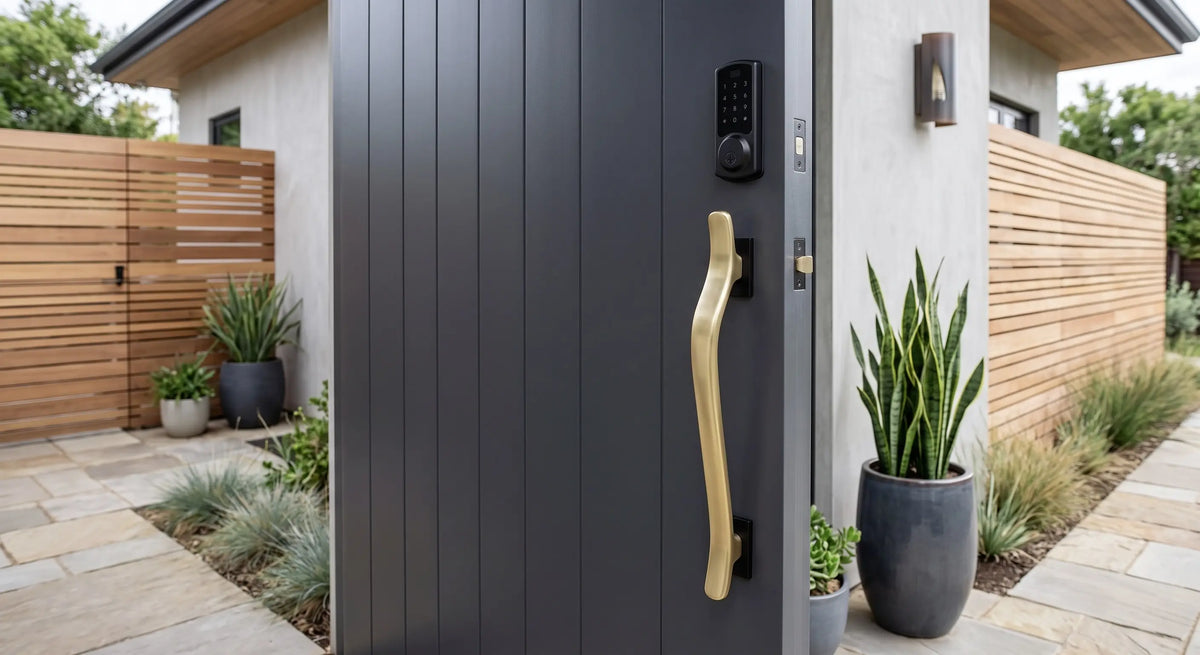
A wooden pull handle can give a front door warmth and character that metal hardware often cannot, but exterior doors expose hardware to a much harsher environment than interior doors. Sun, rain, humidity and changing temperatures all matter. This guide explains when wooden door handles work well outdoors, why teak is commonly chosen, and what to check before installing a wood pull on an exterior door.
Yes, a wooden door handle can be suitable for an exterior door when the wood, protective finish, mounting hardware and maintenance are appropriate for the installation. Teak is particularly useful for this application because it is a durable hardwood with natural oils. However, no wooden handle should be treated as maintenance-free, especially when it is fully exposed to direct sun and rain.
Why Are Exterior Door Handles Different?
An interior pull handle lives in a relatively stable environment.
A front or exterior door may experience direct sunlight in the morning, rain later in the day, high summer temperatures, winter cold and repeated changes in humidity.
That means an exterior wooden pull needs to be considered as a complete system rather than simply a piece of attractive timber.
The same wooden handle may require very little attention under a deep covered porch but experience much stronger weathering on an uncovered west-facing entrance.
Why Is Teak a Good Wood for an Exterior Door Handle?
Not every wood species behaves the same way outside.
Teak is valued for its durability, dimensional stability and naturally occurring oils. These characteristics are part of the reason it has historically been used for outdoor furniture, marine applications and other products that experience moisture and changing environmental conditions.
For a door pull, teak also has another practical benefit: it feels warm and natural in the hand while still providing the substantial feel expected from architectural hardware.
Teak's natural properties do not make a finished handle completely waterproof or maintenance-free. The protective coating, exposure level and ongoing care still matter.
If you want to compare teak with other common furniture and architectural woods, see our Teak Wood vs Other Woods guide .
Covered Entrance vs Fully Exposed Door
One of the most useful questions to ask before choosing an exterior wooden handle is: How much weather will actually reach it?
| Installation | Typical Exposure | What to Expect |
|---|---|---|
| Deep covered porch | Limited direct rain and sun | Generally easier on the wood and finish |
| Recessed apartment entrance | Low to moderate exposure | Often similar to a sheltered exterior environment |
| Partially covered front door | Occasional direct rain or sun | Requires periodic inspection and care |
| Fully exposed entrance | Direct sun, rain and weather changes | Finish and maintenance become more important |
| Commercial exterior entrance | Weather plus frequent handling | Construction and mounting strength are especially important |
This does not mean wooden pulls should only be installed beneath roofs. It means the expected exposure should influence the material, finish and maintenance plan.
Does Sunlight Affect a Wooden Door Handle?
Yes. Repeated exposure to sunlight can gradually change the appearance of natural wood and its finish.
The degree of change depends on the wood, coating, orientation of the entrance and amount of direct exposure. A south- or west-facing entrance with strong afternoon sun may age differently from a shaded doorway.
Natural changes in tone do not automatically mean the handle has failed. Wood is a natural material, and some visual aging should be expected over time.
What About Rain and Humidity?
An exterior pull should be able to handle normal environmental moisture, but water should not be intentionally allowed to remain trapped around mounting points or damaged finish areas.
Rain exposure also makes the quality of the mounting hardware important. A high-quality wooden pull attached with appropriate metal hardware is a different system from an untreated piece of wood attached with unsuitable fasteners.
If an entrance receives heavy direct rain, occasionally inspect the handle, brackets and finish. Catching a loose fixing or damaged coating early is easier than repairing a neglected installation later.
Why Is the Protective Finish Important?
The finish creates an additional protective layer over the wooden surface and influences how the handle responds to normal handling and environmental exposure.
Wood Ceylon exterior-capable teak pulls are hand-sanded and finished with a sealer and protective top coat.
For example, our 15-inch solid teak front door pull is handcrafted from solid teak and sealed with a protective clear top coat.
The 20.5-inch teak entry door pull uses the same general approach for larger entrance doors.
- Inspect the finish periodically
- Wipe away dirt and surface residue
- Address coating damage before it becomes extensive
- Follow the maker's refinishing recommendations
- Keep mounting points secure
- Assuming any wooden handle is permanently waterproof
- Using harsh chemicals without checking the finish
- Applying random oils over an existing top coat
- Ignoring loose brackets
- Leaving damaged finish untreated for long periods
What Hardware Should an Exterior Wooden Pull Use?
The wooden grip receives most of the visual attention, but the brackets and fasteners carry the load.
Exterior door hardware should use suitable corrosion-resistant components and be correctly matched to the door material and thickness.
Many current Wood Ceylon architectural pulls use stainless steel mounting brackets together with the teak handle. The combination gives the natural wooden grip a strong structural connection to the door.
The mounting system also changes depending on whether the handle is:
- Single-sided
- Back-to-back
- Mounted on timber
- Mounted on metal or aluminum
- Mounted through glass
If you are deciding between one pull and a matching pair, see our Single-Sided vs Back-to-Back Door Pull Handles guide .
Can Wooden Pull Handles Be Used on Metal or Aluminum Exterior Doors?
Yes, provided the mounting method is suitable for the door construction.
A wooden pull does not require the door itself to be made from wood. The handle and door are separate components connected by the mounting hardware.
A teak pull can therefore create a warm material contrast against:
- Black aluminum doors
- Powder-coated metal doors
- Glass-and-metal entrances
- Timber doors
- Architectural panels
Wood Ceylon's current front and entry pulls offer mounting configurations for wood, glass, aluminum, metal and compatible solid surfaces.
What Size Wooden Pull Is Best for an Exterior Door?
The correct size depends on the scale of the entrance.
A standard residential door can often use a relatively restrained pull, while a tall pivot door or commercial entrance may look better with longer architectural hardware.
| Entrance Type | Practical Starting Range | Visual Effect |
|---|---|---|
| Compact exterior door | 12"–16" | Subtle and proportional |
| Standard residential front door | 15"–24" | Balanced architectural presence |
| Large double entrance | 20"–31" | Stronger visual statement |
| Tall pivot / statement door | 24"–36"+ | Matches oversized door proportions |
These are visual starting ranges rather than fixed rules.
For a more detailed explanation of overall length, projection and mounting spacing, read our Door Pull Handle Size Guide .
What Exterior Door Pull Size Does Wood Ceylon Offer?
The current collection covers several different entrance scales.
| Example | Length | C/C | Good Fit For |
|---|---|---|---|
| Front Door Pull 022 | 15" | 10" | Standard residential entrances |
| Modern Front Door Pull 031 | 16.5" | 9" | Modern front and architectural doors |
| Entry Door Pull 010 | 20.5" | 15" | Larger front and entry doors |
| Patio Door Pull 009 | 22" | 13.5" | Patio, double and tall sliding doors |
| Statement Pull 012 | 22.5" | 16.5" | Heavy architectural entrances |
You can compare current designs in our wooden door handle and pull collection .
Should You Use a Single-Sided or Back-to-Back Pull Outside?
Exterior use does not automatically determine whether you need one handle or two.
Choose a single-sided pull when you only need the large wooden grip on one face of the door.
Choose a back-to-back set when you want matching full-size handles on both sides.
On a commercial or hospitality entrance, a back-to-back configuration can be especially useful because visitors have a clear full-size grip from either direction.
On a residential front door, a large exterior pull may be paired with a different interior hardware setup, making a single-sided configuration more appropriate.
What About Center-to-Center Spacing?
If the exterior door is already drilled, center-to-center spacing may be the most important measurement when selecting a replacement pull.
Measure from the center of the upper mounting hole to the center of the lower mounting hole.
Do not confuse that measurement with the full length of the handle.
Our Center-to-Center Door Handle Measurement Guide explains the process step by step.
How Do You Maintain a Wooden Exterior Door Handle?
Exterior maintenance does not need to be complicated.
The goal is to keep the handle clean, monitor the finish and catch any hardware movement before it becomes a problem.
Use a soft damp cloth for routine cleaning rather than allowing outdoor dirt and residue to build up.
Look for areas where the protective coating appears worn, scratched or damaged, particularly on highly exposed entrances.
Make sure the handle remains firmly mounted and that repeated use has not loosened the fixing points.
If the finish eventually needs attention, identify the existing coating before applying oils, waxes or new top coats.
There is no single schedule for every exterior handle. A sheltered entrance may need much less attention than a handle exposed to strong sun, heavy rain or frequent commercial use.
How to Choose a Wooden Pull Handle for an Exterior Door
Before ordering, work through these questions.
If the door is already installed, photographs can also help when confirming a custom pull.
When Is a Wooden Exterior Pull a Good Choice?
- You want a warmer alternative to an all-metal handle
- Your entrance uses natural materials
- You value handcrafted architectural details
- You are prepared for normal exterior maintenance
- You want a custom size or C/C measurement
- You expect completely maintenance-free natural wood
- The handle will face extreme exposure without inspection
- You cannot confirm the door measurements
- You need hardware with no natural variation in appearance
Wood Ceylon Teak Pull Handles for Exterior Entrances
Wood Ceylon's architectural pull handles are individually handcrafted from solid teak and available in multiple lengths, shapes and mounting configurations.
For a standard residential entrance, the 15-inch Solid Teak Front Door Pull offers a compact 10-inch C/C mounting pattern.
For a larger architectural entrance, the 20.5-inch Teak Entry Door Pull provides a longer profile with 15-inch center-to-center spacing.
Patio doors and taller sliding panels can use the 22-inch Teak Patio Door Pull .
Custom lengths, mounting distances and finishes are also available for many designs.
Browse Wood Ceylon Wooden Door Pull Handles for current sizes, finishes and mounting options.
Frequently Asked Questions
Can wooden door handles be used outside?
Yes. A wooden handle can be used on an exterior door when the wood species, protective finish, mounting hardware and maintenance are appropriate for the level of weather exposure.
Is teak good for an exterior door handle?
Teak is a strong choice because it is a durable hardwood with naturally occurring oils and a long history of use in moisture-prone and outdoor environments. A finished teak handle still requires normal care.
Are wooden exterior door handles waterproof?
It is better not to describe natural wooden handles as completely waterproof. Appropriate wood species and protective finishes can make them suitable for exterior use, but exposure and maintenance still matter.
Will sunlight change the color of a wooden door pull?
Natural wood and finishes can gradually change in appearance with prolonged sunlight and weather exposure. The amount of change depends on the material, finish and location of the entrance.
Can I install a teak handle on a metal exterior door?
Yes, provided the mounting system is suitable for the metal door's construction and thickness. The pull itself does not require the door to be made from wood.
What size wooden handle is best for a front door?
For many standard residential front doors, approximately 15 to 24 inches is a useful starting range. Taller or oversized architectural doors may suit longer pulls.
Are wooden pull handles suitable for commercial entrances?
They can be, provided the handle construction, mounting hardware and installation are suitable for the door and expected usage. High-traffic entrances should be inspected periodically for secure mounting.
How often should I maintain an exterior wooden door handle?
There is no fixed schedule for every installation. Inspect the handle periodically and more frequently when it receives direct sun, rain or heavy use. Clean it gently and address finish or mounting issues when they appear.
Can Wood Ceylon make a custom exterior door pull?
Yes. Custom overall lengths, center-to-center mounting distances and finishes are available for many Wood Ceylon handmade teak door pulls. Provide your door material, thickness and required measurements before ordering.



Leave a comment