


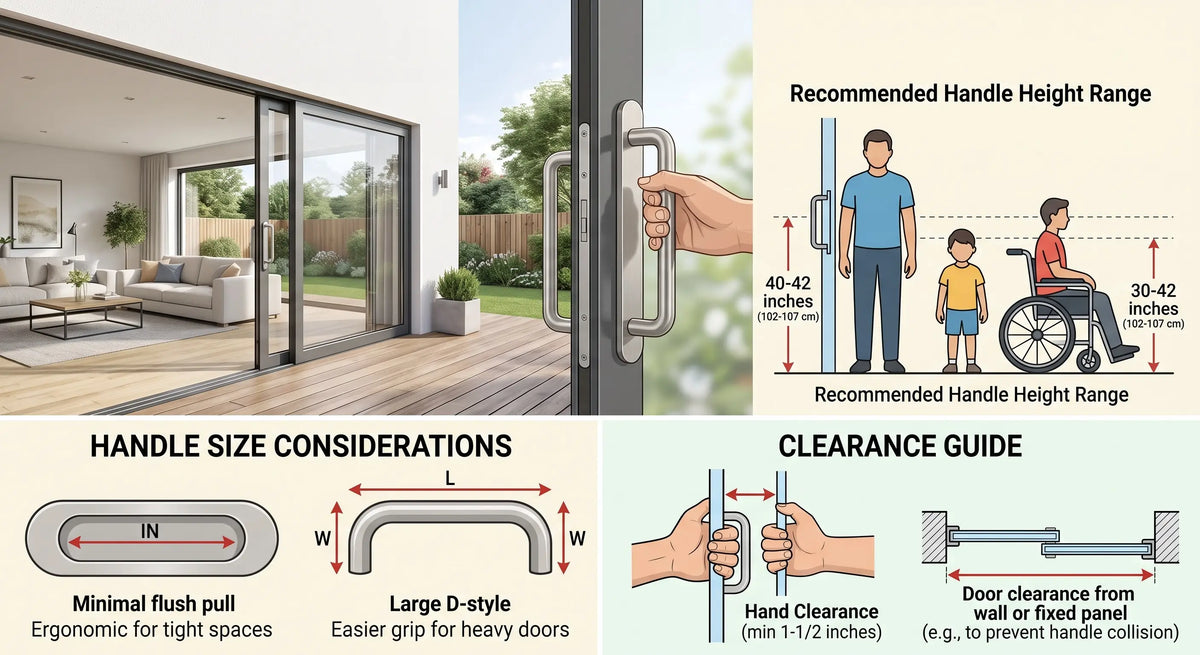
A sliding or barn door pull can look simple, but its position affects much more than appearance. The handle needs to be comfortable to reach, far enough from the door edge for secure mounting, and positioned so it does not hit a wall, frame or adjacent panel when the door opens. This guide explains practical sliding door handle placement, including height, pull size, center-to-center spacing and the clearance checks to make before drilling.
- Quick answer
- How high should the handle be?
- How to measure placement height
- What size pull should you choose?
- How far from the door edge?
- Wall and sliding clearance
- Single-sided vs back-to-back
- Barn vs sliding doors
- Glass sliding doors
- Common placement mistakes
- Wood Ceylon size examples
- Frequently asked questions
Place a sliding door pull where the main grip area feels natural to reach while standing, then confirm that the handle and its mounting brackets will clear the wall, frame or adjacent panel through the entire sliding path. For many residential installations, positioning the usable grip around normal hand height is a practical starting point, but the final position should match the users, door size and any applicable accessibility requirements.
How High Should a Sliding Door Pull Handle Be?
There is no single ideal height for every residential sliding or barn door.
The handle should sit where a person can reach and pull the door naturally without bending down or reaching unnecessarily high.
For many home installations, a useful starting point is to position the main usable grip area around 36 to 42 inches above the finished floor, then adjust the final location to suit the handle length, door proportions and people using the door.
The 36–42 inch range is a practical residential starting point, not a building-code requirement. Commercial, public and accessible installations may have specific requirements that should be checked before drilling.
What About Accessible Doors in the United States?
For doors subject to U.S. accessibility requirements, placement should not be based only on appearance.
The 2010 ADA Standards state that operable parts of door and gate hardware should generally be positioned between 34 inches and 48 inches above the finished floor or ground.
The standards also state that when sliding doors are fully open, the operating hardware should remain exposed and usable from both sides.
Always confirm which accessibility and building requirements apply to the specific project, especially for commercial, hospitality and public installations.
How Do You Measure Sliding Door Handle Height?
Do not measure only to the top or bottom of a long pull.
What matters most ergonomically is the section of the handle people will actually grab.
Start from the actual finished floor surface rather than a subfloor or unfinished threshold.
Stand naturally beside the door and identify where your hand reaches the door comfortably. Use this as the starting point for the handle's usable grip area.
Hold or temporarily tape a cardboard template equal to the full handle length against the door. Check whether the top and bottom look balanced.
Make sure both fixing points land on a suitable structural area of the panel and do not interfere with locks, frames or other hardware.
Move the door from fully closed to fully open and confirm the proposed handle location remains usable and does not collide with anything.
What Size Pull Handle Is Best for a Sliding Door?
Handle length should reflect the size and visual weight of the sliding panel.
A small closet slider may look balanced with a shorter pull, while a full-height barn door or large glass panel usually benefits from a longer architectural handle.
| Door Type | Practical Starting Range | Typical Effect |
|---|---|---|
| Small closet / wardrobe slider | 10"–16" | Compact and visually restrained |
| Standard sliding interior door | 14"–20" | Comfortable grip with balanced proportions |
| Barn door | 16"–24" | Stronger grip and better scale on larger panels |
| Tall glass / architectural slider | 20"–31"+ | More substantial architectural presence |
These ranges are visual starting points rather than fixed standards.
If you want a detailed explanation of overall length, projection and mounting spacing, read our Door Pull Handle Size Guide .
How Far Should a Sliding Door Handle Be from the Door Edge?
There is no universal edge distance that suits every sliding door.
The correct position depends on:
- Door construction
- Width of the stile or solid mounting area
- Handle bracket size
- Mounting-hole diameter
- Door material
- Lock or latch position
- Clearance when the door opens
The handle should be close enough to the operating edge that it feels natural to use, but not so close that the mounting holes weaken the edge of the panel or interfere with other hardware.
For glass sliding doors, hole location and edge distance should be confirmed with the glass fabricator or door manufacturer before the glass is tempered or drilled.
How Much Clearance Does a Sliding Door Pull Need?
Clearance is one of the most commonly overlooked parts of sliding-door handle installation.
A handle that works perfectly while the door is closed may hit a wall, frame, trim or adjacent panel as soon as the door slides open.
Before drilling, measure the handle's projection — the distance from the face of the door to the outermost part of the grip.
Then compare that measurement with the available gap behind or beside the moving panel.
The available space should be greater than the handle projection, with enough additional clearance that the handle does not scrape or strike the adjacent surface during normal use.
Wall-Mounted Barn Doors Need Extra Attention
A barn door usually slides parallel to the wall.
If a full pull is installed on the wall-facing side, it may collide with the wall or prevent the door from opening as far as intended.
This is one reason many barn-door installations use a full pull on the room-facing side and a lower-profile solution on the wall-facing side.
Single-Sided or Back-to-Back for a Sliding Door?
This decision should be made only after checking clearance.
| Configuration | Advantages | Check Before Ordering |
|---|---|---|
| Single-Sided Pull | Simpler when the rear side has limited clearance | How the opposite side will be operated |
| Back-to-Back Set | Full-size grip from both sides | Rear-side wall and panel clearance |
| Low-Profile Rear Hardware | Useful when one side slides close to a wall | Compatibility with the door system |
A back-to-back set can work very well on a sliding glass or freestanding sliding panel when there is enough space on both sides.
For a barn door sliding close to a wall, a full rear pull may not have enough room.
For a complete comparison, read our Single-Sided vs Back-to-Back Door Pull Handles guide .
Is Barn Door Handle Placement Different from a Regular Sliding Door?
The basic ergonomic principles are similar, but barn doors often introduce more wall-clearance problems.
- Check wall-facing clearance
- Keep the grip easy to reach near the closing edge
- Use a handle visually proportional to the large panel
- Check stops and track position before drilling
- Consider a low-profile rear-side solution
- Check adjacent-panel clearance
- Confirm the pull stays accessible when fully open
- Check frame and trim clearance
- Match the mounting system to the panel material
- Confirm C/C spacing before drilling
Where Should a Barn Door Pull Be Positioned Horizontally?
A barn door pull is usually most practical near the closing edge rather than in the center of the panel.
This gives the user better leverage and keeps the grip close to the direction from which the door is normally operated.
However, leave enough material around the mounting points for a secure installation. Rustic plank doors, framed doors and engineered panels can have very different internal structures, so check the construction before drilling.
How Do You Place a Pull Handle on a Glass Sliding Door?
Glass-door installation requires more planning because the mounting holes are normally fixed before final installation.
Confirm the following before ordering the handle:
If the glass is already drilled, the new handle should match the existing mounting pattern.
For glass-specific mounting information, see our Back-to-Back Door Handles for Glass Doors guide .
Why Does Center-to-Center Spacing Matter?
Center-to-center spacing, or C/C, is the distance between the centers of the two mounting holes.
It is different from overall handle length.
For example, Wood Ceylon's 16-inch Sliding Door Pull uses a 12-inch center-to-center mounting distance.
Our 17-inch Barn Door Pull also uses a 12-inch C/C pattern.
If you are replacing an existing handle, measure the holes rather than assuming the new pull will fit.
Our Center-to-Center Door Handle Measurement Guide explains the process step by step.
8 Common Sliding Door Handle Placement Mistakes
- Choosing placement based only on appearance
- Installing the handle too high or too low
- Forgetting rear-side wall clearance
- Ignoring handle projection
- Drilling before checking the full sliding path
- Confusing overall length with C/C spacing
- Installing too close to a weak door edge
- Ordering back-to-back pulls without checking clearance
- Test grip height before drilling
- Use a full-size cardboard template
- Measure handle projection
- Slide the door fully open and closed
- Confirm door structure
- Measure C/C twice
- Check wall and frame gaps
- Confirm the mounting configuration
Use a Full-Size Template Before Drilling
One of the easiest ways to avoid placement mistakes is to make a temporary template.
Cut a strip of cardboard or paper to the same overall length and approximate width as the pull handle.
Create a simple full-scale outline using the dimensions from the product specification.
Add the exact upper and lower fixing centers to the template.
Use removable tape so you can move the template up, down or sideways without damaging the finish.
Step back and check whether the size and position look proportional to the entire panel.
Open and close the door fully before transferring any drill marks.
Wood Ceylon Sliding & Barn Door Pull Examples
Wood Ceylon offers several handmade teak pulls that suit different sliding and barn-door scales.
| Handle | Overall Length | C/C Spacing | Good Fit For |
|---|---|---|---|
| Sliding Door Pull 006 | 16" | 12" | Sliding, wardrobe and closet doors |
| Barn Door Pull 004 | 17" | 12" | Barn, sliding and heavier interior doors |
| Ladder Pull 011 | 24" | 16.5" | Tall barn, double and oversized doors |
The 16-inch Teak Sliding Door Pull is a compact option with a 12-inch C/C mounting pattern.
For a slightly larger barn-door proportion, see the 17-inch Teak Barn Door Pull .
Taller panels can use the 24-inch Teak Ladder Pull , which uses 16.5-inch center-to-center spacing.
Browse the complete Wood Ceylon Wooden Door Handle Collection to compare other lengths, shapes and mounting configurations.
Can You Order a Custom Sliding Door Pull?
Yes. Many Wood Ceylon handmade pulls can be produced with custom overall lengths, center-to-center mounting distances and finishes.
Custom sizing can be useful when:
- The existing holes use a non-standard C/C measurement
- The door is unusually tall
- You want matching pulls across several panels
- A standard handle is too large for the available wall clearance
- The architectural proportions require a specific length
If your sliding door runs close to a wall or another panel, send a photo together with the door thickness, C/C measurement and available clearance. This makes it easier to confirm the most practical configuration.
Frequently Asked Questions
How high should a sliding door pull handle be?
For many residential installations, placing the main usable grip around 36 to 42 inches above the finished floor is a practical starting point. Adjust the final position for the users, handle length, door design and any applicable accessibility requirements.
How high should accessible door hardware be?
Under the 2010 ADA Standards in the United States, operable parts of applicable door hardware are generally positioned from 34 inches minimum to 48 inches maximum above the finished floor or ground. Confirm the requirements that apply to your specific project.
Where should a barn door handle be placed?
A barn door pull is usually most practical near the closing edge of the panel at a comfortable hand height. Check wall clearance, door structure and mounting points before drilling.
What size pull handle is good for a barn door?
Handles around 16 to 24 inches are useful starting points for many full-size barn doors. Smaller panels may suit shorter pulls, while oversized architectural doors may look better with longer handles.
Can I use a back-to-back handle on a sliding door?
Yes, if there is enough clearance on both sides. Check whether the rear handle will contact a wall, frame or adjacent panel when the door is fully open.
Why is handle projection important on a sliding door?
Projection tells you how far the handle extends from the door surface. If the door slides close to a wall or another panel, too much projection can cause the handle to collide with that surface.
Is center-to-center spacing the same as handle length?
No. Overall length measures the complete handle from end to end, while center-to-center spacing measures only the distance between the two mounting points.
Can I use a wooden pull on a glass sliding door?
Yes, when the mounting system is designed for glass and the hole spacing, glass thickness and hole diameter are compatible with the handle hardware.
Can Wood Ceylon make a custom sliding-door handle?
Yes. Custom overall lengths, center-to-center measurements and finishes are available for many Wood Ceylon handmade teak door pulls.



Leave a comment