


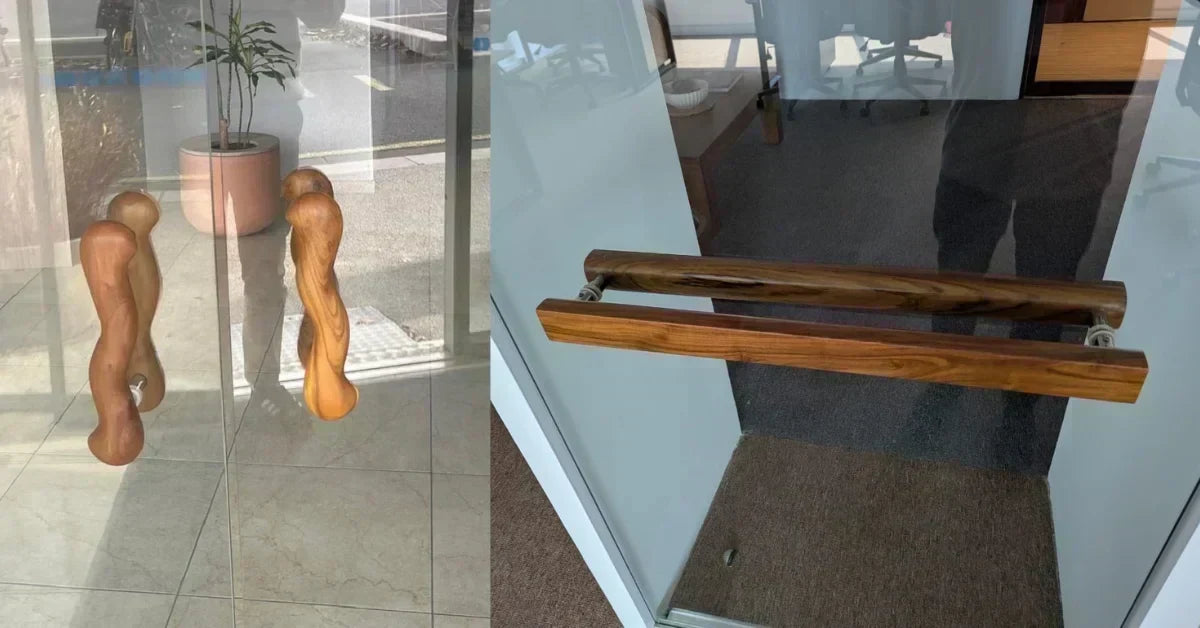
If you're shopping for a glass door handle and keep seeing terms like "double sided," "double-sided set," or "back-to-back," you're not alone. These phrases often get mixed up — yet the difference matters, because glass can't be "adjusted" like timber or metal once holes are drilled.
This guide explains what back-to-back door handles really are, how to measure your door correctly, which fixings are safest, and the common mistakes that cause poor fitment — or worse, glass damage.
What "back-to-back" actually means
Back-to-back door handles — also called a double-sided door handle set — are two pull handles installed on opposite sides of the same door, using the same drilled holes and shared through-bolts.
- Two handles, front and back
- Aligned directly opposite each other
- Fixed through the glass using the same hole positions
They're popular because they look clean and symmetrical, give an equal pull from both sides, and work well for shower doors, shopfronts, office partitions, display cabinets, and interior glass doors. If you need a pull handle on both sides, a back-to-back set is usually the correct setup.
Single-sided vs back-to-back
Not every pair of handles sold together is a true back-to-back set — here's the practical difference.
| Feature | Single-sided | Back-to-back |
|---|---|---|
| Handles included | One — other side may be a knob or plate | Two, designed as a matched pair |
| Fixing | Varies by design | Through-bolted, sharing the same holes |
| Best for | Display doors, staff-only sides | Shopfronts, offices, showers, cabinets |
| Pull from both sides | No | Yes |
Some sellers call any two handles in a box "double-sided," even if they aren't designed to mount back-to-back. Make sure the listing states back-to-back and specifies through-bolt fixing — hole spacing between handles that weren't designed as a pair often won't match.
Measurements to confirm before ordering
Glass can't be "adjusted" once holes are drilled, so getting these numbers right before ordering saves a return — or a cracked pane.
Glass thickness is typically 8–10 mm or 10–12 mm. It determines the correct bolt length, ensures spacers and gaskets fit properly, and reduces the risk of loosening or cracking over time.
Centre-to-centre hole spacing (C/C) is the distance between the centres of the two holes — measure centre to centre, not edge to edge. This is one of the most important numbers for glass, because holes can't be nudged wider the way they can in wood.
Hole diameter matters because glass holes have limited tolerance: too small and the bolt won't pass through, too large and the handle won't clamp securely.
Handle length vs grip length — the overall length is the end-to-end size, but grip length is what you actually hold. A longer handle can look great, but you still want a comfortable grip area for the door.
Offset from the door edge is how far the holes sit from the glass edge. Drilling too close to the edge increases the risk of cracks, especially on heavy doors.
Fixing types — and which one you need
A through-bolt (also called a through-screw) passes through the glass and clamps both handles together. It's the standard for back-to-back sets. A one-sided fixing with a backplate is used instead when drilling both faces isn't possible — typically on lightweight or temporary installations.
- Strongest and most secure fixing
- Clean finish, ideal for modern frameless glass
- Best for high-traffic doors like shopfronts and offices
- Not as secure as through-bolting
- Performance depends on the plate or adhesive
- Less ideal for a true back-to-back pull
For any glass door handle, gaskets are not optional — they prevent metal-to-glass contact, reduce vibration, and help distribute pressure evenly. A proper set includes gaskets at every contact point, correctly sized washers, and through-bolts matched to your glass thickness.
Installing your handles
A simple overview for fitting glass door pull handles safely. If you're unsure at any step, use a professional installer — glass is unforgiving of a rushed fit. You'll typically need a tape measure, an Allen key (often included), a soft cloth, and a level.
Confirm measurements and hold both handles in place before inserting a single bolt.
Never skip these — they're what stops metal touching glass.
Pass them through the glass holes and align both handles front and back.
Alternate sides as you go, and stop the moment it feels snug — overtightening is the top cause of stress cracks.
Confirm final alignment and grip feel from both sides of the door.
Common mistakes
This is the part that saves the most headaches — and exactly where most buyers go wrong.
Wrong hole spacing (C/C). The handle won't fit, and forcing it can chip or crack the glass.
Wrong screw length for the glass thickness. Too short and it won't tighten properly; too long and it can bottom out or create stress points.
Missing gaskets or washers. Metal touching glass can cause chips and cracks over time, even if it seems fine on day one.
Overtightening. One of the fastest ways to create stress in glass — tighten gradually and evenly.
Installing too close to the edge. The closer the hole is to the edge, the higher the risk, especially on heavy or frequently used doors.
Mixing handles that aren't designed as a pair. Not all "pairs" are true back-to-back sets — misaligned holes and uneven clamping can look bad and fail early.
Choosing the right material and finish
The right finish depends on your door's location and environment. Indoor office partitions work well with most finishes, while semi-outdoor shopfronts need materials that resist corrosion. Bathrooms and coastal climates are harshest on finishes — choose durable materials and keep the surface clean to reduce staining and wear.
Teak pairs a warm, natural look with modern glass and holds up well to moisture — a practical choice for humid climates. Every Wood Ceylon handle is hand-finished from Grade A teak heartwood, needing only an occasional wipe-down to stay looking right.
Frequently asked questions
What does back-to-back mean for door handles?
Two handles mounted on opposite sides of the same glass door, aligned and fixed through the same holes using through-bolts.
Can back-to-back handles be installed on tempered glass?
Yes — if the glass is already drilled and tempered correctly. Tempered glass can't be drilled afterward, so holes must be right from the start.
What is the standard hole spacing for glass door pull handles?
There isn't one universal standard. Always measure your door's centre-to-centre (C/C) spacing before ordering.
Do I need one handle or a set of two?
If you need a pull from both sides, you need a back-to-back set. If you only pull from one side, a single-sided option may be enough.
What glass thickness do I need to know before buying?
The thickness in millimetres — for example 10 mm or 12 mm — so the correct bolt length and gasket fit can be selected.
Can I reuse existing holes in a glass door?
Usually yes, as long as the new handle matches the existing hole spacing (C/C) and hole diameter.
How tight should glass door handles be?
Snug and secure, but not forced. Tighten evenly and stop before you feel strong resistance, to avoid stressing the glass.
Send us your measurements and we'll recommend the correct back-to-back door pull set for your glass door.



Leave a comment