


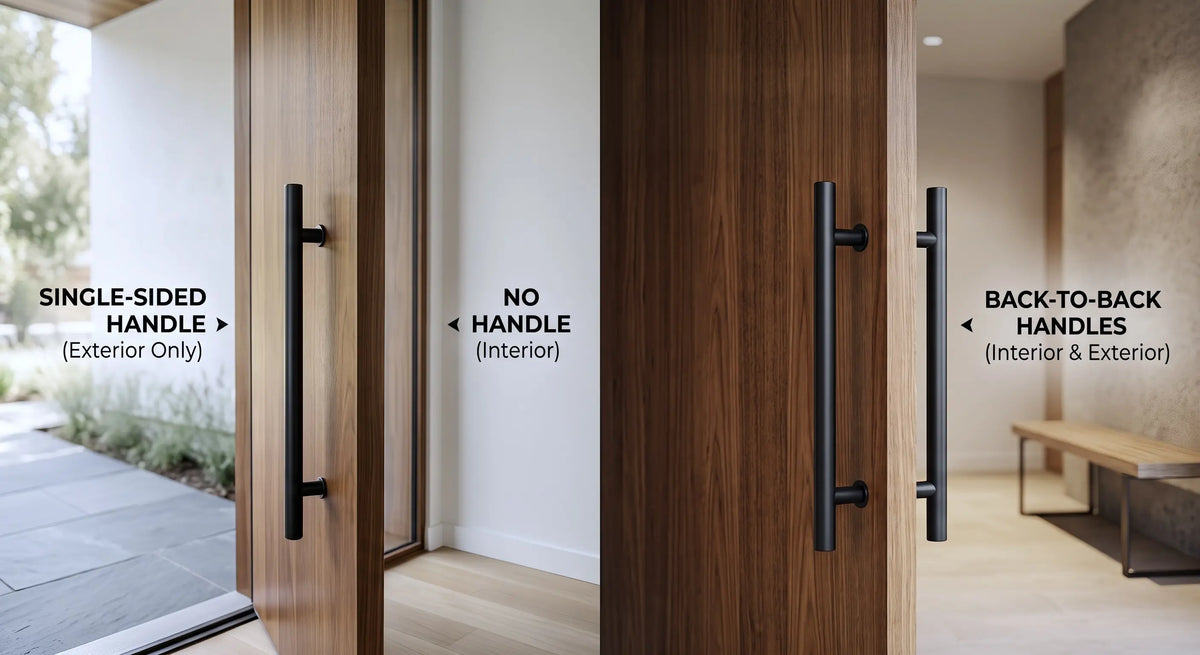
When ordering a door pull handle, choosing the right length is only part of the decision. You also need to decide whether you want one handle on a single side of the door or two matching handles mounted back-to-back. This guide explains the difference between single-sided and back-to-back door pull handles, where each type works best, and what measurements to check before ordering.
A single-sided door pull gives you one handle on one side of the door. A back-to-back set gives you two matching pulls, one on each side, normally aligned through the same mounting holes. Choose single-sided when only one side needs a pull. Choose back-to-back when users need a full pull handle from both sides of the door.
What Is a Single-Sided Door Pull Handle?
A single-sided pull uses one visible handle on one face of the door.
The opposite side does not receive a matching full-size pull. The exact fixing method depends on the door material, handle design and supplied mounting hardware.
Single-sided pulls are commonly useful when:
- Only one side of the door needs a prominent pull
- The other side uses different hardware
- The pull is primarily decorative or architectural
- You are fitting a sliding or barn-style door
- The door layout does not require matching pulls on both sides
Single-sided = one full pull handle. It is the simpler option when you do not need an identical grip on the opposite face of the door.
What Is a Back-to-Back Door Handle Set?
A back-to-back set uses two pull handles positioned directly opposite each other, with one handle on each face of the door.
The handles normally align with the same mounting-hole positions and are secured through the door using suitable fixing hardware.
This configuration is especially common on glass entrance doors, office doors, shopfront doors, large double doors and other applications where people need a proper pull from either direction.
Two handles, one on each side, aligned to the same C/C mounting pattern. If you want the same wooden pull visible from both sides of the door, this is usually the configuration to choose.
Single-Sided vs Back-to-Back Door Pull Handles
| Feature | Single-Sided Pull | Back-to-Back Set |
|---|---|---|
| Number of full handles | One | Two |
| Handles both sides? | No matching full pull on opposite side | Yes |
| Mounting alignment | Depends on fixing system | Two handles normally align through the same holes |
| Typical cost | Lower because only one pull is required | Higher because the set includes two pulls |
| Glass doors | Possible for suitable applications | Very common when access is needed from both sides |
| Wood doors | Common | Also suitable |
| Best for | One-sided access or mixed hardware | Matching grip from both sides |
Single-Sided or Back-to-Back for a Wooden Door?
Both configurations can work on wooden doors.
The better choice depends mostly on how the door is used.
- You only want a large pull on the main visible side
- The opposite side uses different hardware
- You want a simpler installation
- You do not need matching pulls on both sides
- You want the same handle on both faces
- People regularly pull the door from either side
- The door is part of a premium entrance
- You want symmetrical hardware
For example, Wood Ceylon's 15-inch solid teak front door pull can currently be ordered as a single-sided pull or a double-sided back-to-back set.
Single-Sided or Back-to-Back for a Glass Door?
Back-to-back pull handles are especially common on glass doors because the same pre-drilled holes can be used to align a handle on each side.
This works well for:
- Office glass doors
- Shopfront entrances
- Hotel and hospitality doors
- Glass interior doors
- Some shower-door applications
If people need to pull the door from both directions, a back-to-back set usually provides the more intuitive configuration.
A single-sided pull can still be suitable in an application where only one side requires a full handle, but the hardware must be selected for that specific installation.
Existing glass-door holes need to match the new handle's mounting pattern. Before ordering, confirm the glass thickness, hole diameter and center-to-center spacing.
For glass-specific measurements and fixing details, read our Back-to-Back Door Handles for Glass Doors guide .
Which Handle Configuration Works Best for Different Doors?
The table below is a practical starting point rather than a fixed rule. Door construction and the way people move through the opening should ultimately determine the configuration.
| Door Type | Common Choice | Why |
|---|---|---|
| Residential front door | Single or back-to-back | Depends on interior hardware and preferred appearance |
| Glass office door | Back-to-back | Provides a full pull from both directions |
| Shopfront glass door | Back-to-back | Easy access from both sides |
| Barn door | Often single-sided | One prominent pull may be enough depending on the sliding system |
| Sliding door | Single or back-to-back | Depends on clearance and access from each side |
| Double entrance doors | Single or back-to-back | Depends on whether matching interior pulls are required |
| Large pivot door | Often back-to-back | Creates a symmetrical architectural feature and usable grip on both sides |
What About Sliding and Barn Doors?
Sliding and barn doors need an additional check: clearance.
A back-to-back set adds a projecting handle to both sides of the door. On some sliding systems, one side of the door moves close to a wall, frame or another panel.
If there is not enough clearance, a full back-to-back set may interfere with the sliding path.
For a sliding door, check how much space is available behind the door when it is fully open. Handle projection can matter just as much as handle length.
How Does the Mounting Differ?
The visible difference is simple—one handle versus two—but the mounting arrangement also changes.
Single-Sided Mounting
A single-sided configuration secures one pull to the chosen side of the door using hardware suitable for the door material and product design.
Because there is no matching pull opposite it, the rear-side fixing arrangement depends on the specific mounting system.
Back-to-Back Mounting
In a back-to-back configuration, both pulls are positioned opposite each other. The mounting points must line up so the two handles share the same center-to-center pattern.
Through-door hardware is then selected to suit the material and thickness of the door.
This is why it is important to provide accurate measurements rather than ordering only by the overall handle length.
Does Center-to-Center Spacing Change?
Normally, no.
If a pull is available in both single-sided and back-to-back configurations, the handle's center-to-center mounting distance remains the same.
What changes is the hardware arrangement and the number of handles.
If you are not sure how to measure your existing fixing holes, see our guide to measuring center-to-center door handle spacing .
Why Does Door Thickness Matter?
Door thickness becomes particularly important when hardware passes through the door.
A thin glass panel and a thick timber entrance door cannot automatically use identical fixing lengths.
Before ordering, record:
Does Handle Length Affect Single vs Back-to-Back Choice?
Not directly.
A 15-inch, 20-inch or 24-inch pull can potentially be offered in either configuration if its mounting system supports it.
Handle length should primarily be selected according to door size, proportion and usable grip area. The single-sided versus back-to-back decision should be based on how the door needs to operate from each side.
For help choosing overall length, see our Door Pull Handle Size Guide .
Can You Convert a Single-Sided Handle to Back-to-Back Later?
Sometimes, but do not assume every installation can be converted without changes.
If the same handle model is available as a back-to-back set and the existing holes match, conversion may be possible with the correct second handle and mounting hardware.
Before making the change, confirm:
- The exact handle model
- Center-to-center spacing
- Door material
- Door thickness
- Existing hole diameter
- Clearance on the opposite side
Glass doors need particular care because existing holes are fixed and cannot simply be repositioned after installation.
7 Common Mistakes When Choosing Single or Back-to-Back Handles
- Ordering one handle when two were expected
- Assuming "double-sided" means one special handle
- Ignoring door thickness
- Forgetting glass-door hole spacing
- Not checking sliding-door clearance
- Confusing overall length with C/C spacing
- Choosing mounting hardware without confirming door material
- Number of handles included
- Single or back-to-back configuration
- Door thickness
- C/C measurement
- Handle projection
- Door material
- Clearance around the installed pull
How Wood Ceylon Handle Options Work
Many Wood Ceylon wooden door pulls are available in multiple mounting configurations, allowing the same basic handle design to be matched to different installations.
For example, our 22-inch teak patio door pull can currently be selected as:
- Single-Sided Door Pull Handle — one pull on one side
- Double-Sided Back-to-Back Handle Set — two pulls, front and back
- Wall-Mount or Handrail Style Handle — for suitable fixed surfaces
It can also be configured for a standard surface or glass-door installation.
Similar mounting choices are available across several designs in our wooden door handle and pull collection .
Which One Should You Choose?
Choose single-sided when one full pull is all you need. Choose back-to-back when you want a matching full-size pull accessible from both sides of the door.
After making that decision, check the door material, thickness, center-to-center spacing, handle projection and overall length before ordering.
If your existing holes or door dimensions do not match a standard configuration, Wood Ceylon can also make many of its handmade teak pulls to custom dimensions.
Frequently Asked Questions
What is a single-sided door pull handle?
A single-sided pull uses one full handle on one face of the door. It is useful when a matching pull is not required on the opposite side.
What does back-to-back mean for door handles?
Back-to-back means two pull handles are mounted directly opposite each other, one on each side of the door, normally using the same aligned mounting-hole positions.
Does a back-to-back set include two handles?
Yes. A back-to-back set consists of two full pull handles, with one installed on each side of the door.
Are back-to-back handles better for glass doors?
They are a common choice when a glass door needs a full pull from both sides. The existing hole spacing, hole diameter and glass thickness must be confirmed before ordering.
Can I use a single-sided pull on a wooden front door?
Yes. A single-sided pull can work well on a wooden front door when only the exterior or one chosen side requires the large pull handle.
Do single-sided and back-to-back handles use the same C/C spacing?
When the same handle design is offered in both configurations, the handle's center-to-center mounting distance normally stays the same. The number of handles and fixing hardware change.
Do I need to know my door thickness for a back-to-back handle?
Yes. Door thickness helps determine the correct through-door mounting hardware, especially for glass, timber and metal doors of different thicknesses.
Can I use back-to-back handles on a sliding door?
Sometimes. Check clearance on both sides first. A projecting handle on the rear face may interfere with a wall, frame or another panel when the door slides open.
Can Wood Ceylon make custom back-to-back door pulls?
Custom sizing is available for many Wood Ceylon handmade pulls. Send your required overall length, center-to-center spacing, door thickness and door material so the configuration can be confirmed.



Leave a comment