


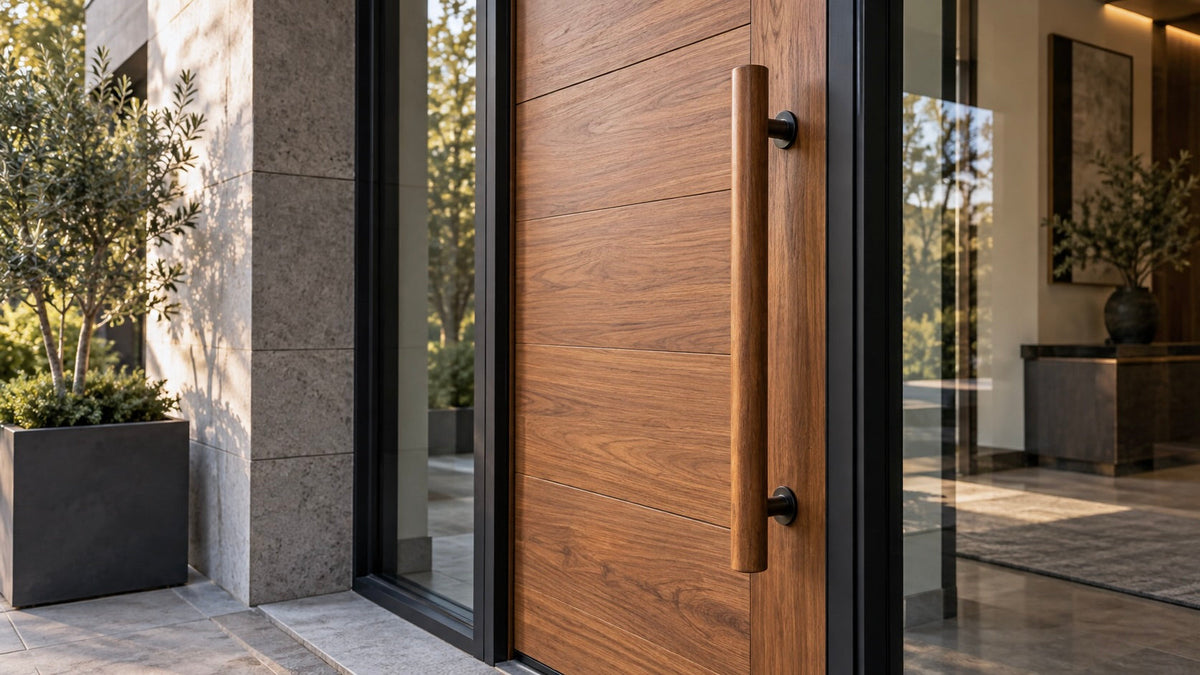
Choosing a door pull handle is not only about style. The handle has to look proportional to the door, provide a comfortable grip, and match the mounting holes or fixing points correctly. This guide explains how door pull handle sizes work, what center-to-center spacing means, and how to choose a practical length for front doors, interior doors, sliding doors, glass doors and oversized entrances.
For many residential doors, a pull handle between about 15 and 24 inches works well as a practical starting range. Shorter pulls suit interior, closet and smaller doors, while 24-inch and longer handles create better visual proportion on tall, double, pivot and statement entry doors. If you are replacing an existing pull, the center-to-center hole spacing is more important than the overall handle length.
The 4 Door Pull Handle Measurements That Matter
Product listings can include several different dimensions, and confusing them is one of the easiest ways to order the wrong handle.
The four measurements worth checking are:
Overall Length
Overall length is the full end-to-end measurement of the handle.
A handle listed as 18 inches long measures approximately 18 inches from its uppermost point to its lowest point. This is usually the measurement buyers notice first because it determines how large the handle looks on the door.
Center-to-Center Spacing
Center-to-center spacing, often written as C/C, is the distance from the center of one mounting hole to the center of the other mounting hole.
This is especially important when replacing a handle on a door that already has holes.
Do not assume an 18-inch handle has 18-inch hole spacing. Overall handle length and center-to-center spacing are usually different measurements.
Projection
Projection is how far the handle sits away from the face of the door.
Enough projection is important because your fingers and knuckles need room to wrap around the handle comfortably. Too little clearance can make even a beautiful handle awkward to use.
Handle Width and Grip Shape
Two handles of the same length can feel completely different depending on their width, thickness and profile. A slim straight pull creates a lighter visual effect, while a thicker sculptural handle makes a stronger statement.
Overall Length vs Center-to-Center: What's the Difference?
The easiest way to understand the difference is to look at a real product.
Wood Ceylon's 15-inch wooden front door pull handle has an overall length of 15 inches, but its mounting holes are spaced 10 inches center-to-center.
Our 18-inch minimalist teak pull handle uses 12-inch C/C spacing.
And the 31-inch oversized pull uses 24-inch center-to-center spacing.
| Wood Ceylon Example | Overall Length | Center-to-Center |
|---|---|---|
| Front Door Pull 022 | 15" | 10" |
| Minimalist Pull 016 | 18" | 12" |
| Ladder Pull 011 | 24" | 16.5" |
| Oversized Pull 013 | 31" | 24" |
What Size Pull Handle Should You Use for Different Doors?
There is no single universal door-handle length because doors vary greatly in width, height, weight and style.
The ranges below are best used as practical visual starting points, not fixed building rules.
| Door Type | Practical Handle Range | Why |
|---|---|---|
| Cabinet / small panel | 8"–14" | Compact scale suits smaller surfaces |
| Interior / closet door | 12"–20" | Comfortable grip without overpowering the door |
| Standard front door | 15"–24" | Balances usability and visual proportion |
| Barn / sliding door | 16"–24" | Longer grip works well on larger moving panels |
| Double / tall entry door | 24"–36"+ | Larger handles suit taller architectural doors |
| Pivot / statement entrance | 31"–36"+ | Oversized hardware better matches the scale |
What Size Pull Handle Is Best for a Standard Front Door?
For many standard residential front doors, a handle in the 15-to-24-inch range gives a balanced, intentional appearance.
A shorter 15- or 16-inch pull usually feels restrained and traditional. An 18- to 20-inch pull creates a stronger visual presence, while a 22- or 24-inch handle begins to feel more architectural.
- Your door is a standard residential size
- You prefer a subtle handle
- The door already has other visible hardware
- You want a clean, balanced appearance
- You want the pull to be a stronger design feature
- The entrance door is wider or visually heavier
- You prefer contemporary architectural hardware
- You want more usable grip length
Wood Ceylon's current collection includes front and entry pulls across this range, including 15-inch, 18-inch, and larger architectural designs.
What Size Handle Should You Use on Tall or Oversized Doors?
Tall doors can make a normal-size pull look visually undersized.
This is particularly noticeable on double entrance doors, pivot doors, hotel-style entries and oversized timber panels.
For these applications, a handle around 24 inches or longer often looks more proportional.
Wood Ceylon's 24-inch teak ladder pull uses 16.5-inch C/C spacing and is designed for tall and double doors.
For even larger entrances, the 31-inch oversized two-tone pull uses a 24-inch C/C measurement.
Wood Ceylon also offers a 36-inch entrance pull for doors where smaller hardware would look visually lost.
Larger is not automatically better. A long handle should look intentional relative to the height and width of the door rather than simply being the biggest size available.
What If Your Door Already Has Mounting Holes?
If you are replacing an existing pull handle, measure the center-to-center spacing before shopping for a new handle.
The existing holes may determine your options more than the overall handle length.
Remove the existing handle if necessary so the fixing points are clearly visible.
Measure from the center of the first hole to the center of the second hole—not from the outer edges.
Through-bolt and back-to-back configurations may require hardware matched to the thickness of the door.
If you want to reuse the existing holes, choose or custom-order a pull with matching center-to-center spacing.
If you are replacing an older handle, our step-by-step door handle replacement guide covers the general replacement process.
Can the Overall Handle Length Change While Keeping the Same C/C?
Yes. Depending on the design, two handles can have different overall lengths while using similar mounting spacing.
This is useful when you want to change the visual scale of the handle without moving the door's existing holes.
With handmade or custom hardware, the overall length and C/C distance can often be adjusted independently within practical structural limits.
Wood Ceylon offers custom overall lengths and center-to-center mounting distances for many of its door pulls.
How Do You Choose a Pull Handle Size for a Glass Door?
Glass requires more planning than timber because the mounting-hole positions cannot simply be adjusted later.
For an existing glass door, confirm:
- Glass thickness
- Hole diameter
- Center-to-center hole spacing
- Distance from the holes to the glass edge
- Whether you need a single-sided or back-to-back handle set
If the door is tempered glass, the hole positions normally need to be decided before tempering. This makes accurate C/C measurements especially important.
For a full explanation of glass-door hardware, read our Back-to-Back Door Handles for Glass Doors guide .
Single-Sided or Back-to-Back: Does It Affect Size?
The visible handle length can remain the same, but the fixing method changes.
| Configuration | What You Get | Common Use |
|---|---|---|
| Single-Sided | One pull handle on one side | Entry, sliding, decorative and one-way access doors |
| Back-to-Back | Two aligned handles using shared holes | Glass, office, shopfront and double-sided access |
| Wall / Handrail | One handle mounted to a fixed surface | Walls, panels and handrail applications |
Where Should a Long Door Pull Handle Be Positioned?
Handle placement depends on door design, lock location, handle length and user comfort.
The grip area should be easy to reach without forcing the user to bend or stretch, while the mounting points should remain clear of locks, door edges and other hardware.
Before drilling:
- Hold the handle against the door at full scale
- Check visual alignment from several feet away
- Confirm clearance from locks and latches
- Check that your hand has enough room behind the grip
- Mark the exact C/C holes only after confirming position
A paper template or a strip of cardboard cut to the full handle length is an easy way to test proportion on the door before ordering or drilling.
Wood Ceylon Door Pull Size Examples
Our current handmade collection includes pulls for smaller interior applications through oversized entry doors.
| Handle | Overall Length | C/C | Typical Use |
|---|---|---|---|
| French Door Pull 026 | 12" | 8" | French, interior and compact doors |
| Front Door Pull 022 | 15" | 10" | Standard front and interior doors |
| Minimalist Pull 016 | 18" | 12" | Modern interior and entry doors |
| Slim Classic Pull 027 | 20" | 18" | Entry and larger interior doors |
| Ladder Pull 011 | 24" | 16.5" | Tall, double and barn doors |
| Oversized Pull 013 | 31" | 24" | Large entrance and pivot doors |
| Grand Entrance Pull 015 | 36" | Custom configuration | Statement and oversized entrances |
Browse the full Wood Ceylon wooden door handle collection to compare available shapes, lengths and mounting options.
Can Wood Ceylon Make a Custom Door Pull Size?
Yes. Many Wood Ceylon pull handles can be made with custom overall lengths, center-to-center distances and finishes.
Custom sizing can be especially useful when:
- You need to reuse existing mounting holes
- Your door is unusually tall or wide
- You need matching handles across double doors
- Your glass door already has fixed hole positions
- You want a specific architectural proportion
When requesting a custom handle, send us:
Frequently Asked Questions
What is the best size pull handle for a front door?
For many standard residential front doors, 15 to 24 inches is a practical starting range. The final choice should depend on the door's scale, existing hardware and the visual effect you want.
What does center-to-center mean on a door handle?
Center-to-center, or C/C, is the distance from the center of one mounting hole to the center of the other. It is one of the most important measurements when replacing a pull handle or using pre-drilled holes.
Is overall handle length the same as hole spacing?
No. Overall length is the full end-to-end size of the handle. Hole spacing is the distance between the mounting points. For example, a 15-inch Wood Ceylon pull can use 10-inch center-to-center mounting spacing.
Can I put a long pull handle on a standard door?
Yes, but proportion matters. A very long handle can visually overpower a smaller door. Test the size against the door before drilling, especially if you are considering a 24-inch or longer pull.
What size pull handle is good for a tall door?
Handles around 24 inches and longer are commonly chosen for taller architectural doors because they create a stronger visual proportion. Very tall or pivot doors may suit 31-inch, 36-inch or custom pulls.
Can I reuse the holes from my old door handle?
Yes, if the new handle has the same center-to-center spacing and the mounting hardware suits the door. Measure the existing holes accurately before ordering.
Do glass door handles need exact C/C spacing?
Yes. Existing glass holes cannot be moved like holes in timber. The replacement handle must match the actual hole spacing and other glass-door measurements.
Can I order a custom center-to-center measurement?
Yes. Wood Ceylon can make custom overall lengths and center-to-center measurements for many handmade door pull designs. Send your door measurements before ordering so the configuration can be confirmed.



Leave a comment