


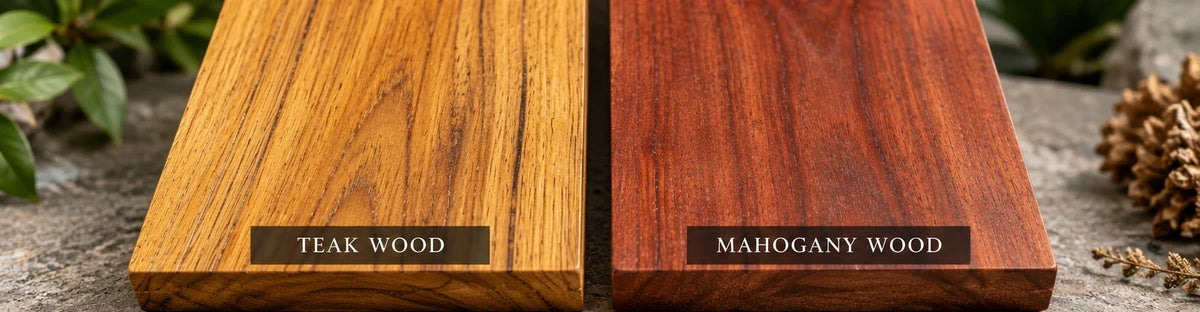
When choosing wood for furniture, doors, or home accessories, two names often come up: teak and mahogany. Both are valued for their natural beauty, distinctive grain, and long-standing use in fine woodworking. But while they may appear similar at first glance, these hardwoods have important differences that can influence how they look, perform, and age.
Teak wood is particularly well known for its natural durability and resistance to moisture, making it a popular choice for outdoor furniture and long-lasting wooden products. Mahogany, meanwhile, is admired for its rich reddish-brown color, refined appearance, and excellent workability.
So, is teak better than mahogany, or does mahogany offer advantages worth considering?
The answer depends on where the wood will be used, the appearance you prefer, and how much maintenance you're willing to undertake.
In this guide, we'll explore seven important differences between teak and mahogany, from color and grain to durability, cost, and everyday applications, helping you choose the right material for your next project.
Teak Wood vs. Mahogany: A Quick Comparison
Before exploring the differences in detail, here's a simple overview of how these two popular hardwoods compare.
| Feature | Teak Wood | Genuine Mahogany |
|---|---|---|
| Scientific name | Tectona grandis | Swietenia species |
| Natural color | Golden to medium brown | Pinkish to reddish brown |
| Grain pattern | Mostly straight, occasionally wavy | Straight, wavy, or interlocked |
| Natural decay resistance | Very high in durable heartwood | Moderate to high, depending on material |
| Moisture exposure | Particularly well suited | Benefits from appropriate protection |
| Workability | Generally good; silica can dull tools | Excellent for cutting, carving, and finishing |
| Typical applications | Outdoor furniture, doors, homeware, architectural details | Fine furniture, cabinetry, decorative panels, interior woodwork |
| Price | Often premium-priced | Varies significantly by species, grade, and source |
Both materials can produce beautiful, long-lasting products. The important distinction is that each offers a different balance of practical performance and visual character.
One detail worth understanding is that the word mahogany is sometimes used to describe several different wood species. In this article, comparisons primarily refer to genuine mahogany from the Swietenia genus, rather than every timber commercially sold under the mahogany name.
1. Appearance and Color: Golden Teak vs. Rich Mahogany
One of the easiest ways to distinguish teak from mahogany is by looking at their natural color.
What Does Teak Wood Look Like?
Freshly finished teak typically displays warm golden-brown tones, sometimes accompanied by darker streaks and natural variations.
Its appearance can range from relatively light honey-colored wood to deeper brown shades, depending on the tree, the particular cut, and the finish applied.
When used indoors, teak develops a warm, established appearance over time. Outdoors, untreated teak gradually weathers toward a silver-gray patina when exposed to sunlight and the elements.
For people who prefer natural materials and warm, organic interiors, teak's distinctive appearance can be especially attractive.
What Does Mahogany Wood Look Like?
Genuine mahogany often begins with a pinkish-brown or light reddish-brown appearance and gradually deepens in color as it ages.
Well-finished mahogany can develop a rich, elegant appearance that complements traditional furniture, classic cabinetry, and sophisticated interior details.
The wood is also known for its natural luster, which can become particularly noticeable after finishing.
Which Looks Better?
This largely comes down to personal preference.
Choose teak if you prefer golden-brown tones, natural warmth, and an organic appearance.
Choose mahogany if you prefer richer reddish-brown colors and a classic furniture aesthetic.
Neither material is inherently more beautiful. The better choice is the one that complements your home's overall design.
2. Wood Grain and Texture: Natural Character vs. Refined Elegance
Color is only part of what makes wood attractive. Grain pattern and texture also influence how a finished product looks and feels.
Teak Wood Grain
 Teak generally has a straight grain, although some boards may show wavy or interlocked patterns.
Its texture is relatively coarse and can vary across the surface, creating natural character that works particularly well in handmade products.
When carefully sanded and finished, teak can develop a smooth, comfortable surface while still retaining the distinctive appearance of natural timber.
This balance makes it appealing for sculptural wooden accessories, furniture components, and handcrafted door handles.
Mahogany Wood Grain
 Genuine mahogany often has a more uniform medium texture, with grain patterns that may be straight, wavy, or interlocked.
Certain boards display attractive figure and light-reflecting effects that enhance the wood's appearance.
Mahogany is particularly appreciated by furniture makers because it can be shaped, sanded, stained, and polished into refined finished pieces.
Which Grain Is Better?
For an organic, nature-inspired appearance, teak is an excellent option.
For furniture with a smooth, elegant, and traditionally refined look, genuine mahogany is equally appealing.
The appearance of either wood can vary considerably from one board to another, so it's worth looking at real samples before making a final decision.
3. Durability and Strength: Which Wood Lasts Longer?
Durability is often one of the first concerns when comparing teak wood and mahogany.
Both are established hardwoods used in furniture and architectural applications, but they have different physical characteristics.
How Durable Is Teak?
Teak heartwood is particularly valued for its natural resistance to decay.
This has helped make teak a long-standing choice for outdoor furniture, boatbuilding, decking, and other applications where environmental exposure is a concern.
Its durability also makes it suitable for frequently used household products, including furniture components, door pulls, and other wooden accessories.
Teak has a Janka hardness rating of approximately 1,070 lbf, providing an indication of its resistance to indentation.
However, even durable teak is not immune to scratches, weathering, or damage. Proper construction, suitable finishes, and routine care still matter.
How Durable Is Mahogany?
Genuine mahogany also offers useful durability, although natural decay resistance can vary depending on the particular material and growing conditions.
Honduran mahogany, a commonly referenced genuine mahogany, has a Janka hardness rating of approximately 900 lbf.
These average values suggest teak is somewhat harder in this particular comparison, but hardness alone does not determine the overall strength or lifespan of furniture.
Mahogany is also appreciated for its dimensional stability, which makes it useful for cabinetry, furniture, and detailed interior woodwork.
Durability Verdict
For applications involving regular moisture exposure or outdoor conditions, teak is often the more practical choice because of its exceptional natural decay resistance.
For indoor furniture and decorative woodwork, both can provide excellent service when properly selected, constructed, and maintained.
4. Water and Moisture Resistance: Is Teak Better Than Mahogany?
Water resistance is one of the most important differences between these two hardwoods.
Wood naturally responds to changes in its environment. Moisture can cause swelling, shrinking, staining, and, under unfavorable conditions, decay.
Teak and Moisture
Teak contains natural oils and other compounds that contribute to its reputation for durability.
Its heartwood performs particularly well in environments where moisture exposure is a concern, which explains its extensive use in outdoor furniture and marine applications.
Teak is therefore a popular material for outdoor seating, garden tables, exterior architectural details, and suitable wooden accessories.
However, teak is water-resistant, not waterproof.
Prolonged standing water, poor drainage, unsuitable construction, and neglected finishes can still cause problems.
Mahogany and Moisture
Genuine mahogany can also perform well in demanding applications, including certain marine and exterior projects.
Its suitability depends on the species, material quality, protective finish, construction method, and exposure conditions.
Mahogany should not automatically be considered unsuitable for outdoor use. However, choosing a properly specified finish and maintaining it is especially important for exposed applications.
Which Is Better for Outdoor Use?
For many outdoor furniture and moisture-prone applications, teak is the preferred choice.
If the project is primarily indoors, the moisture-resistance advantage may be less significant, allowing appearance, budget, and craftsmanship to take greater priority.

5. Maintenance and Care: Which Wood Is Easier to Maintain?
Every wooden product benefits from appropriate care, even when made from naturally durable hardwood.
The maintenance required depends on the wood, its protective finish, and the conditions in which it is used.
Caring for Teak Wood
Indoor teak furniture and accessories are generally straightforward to maintain.
For everyday cleaning, a soft cloth is often sufficient. A slightly damp cloth may be used where appropriate, followed by drying the surface.
Avoid prolonged exposure to standing water, abrasive cleaners, and unnecessary harsh chemicals.
For outdoor teak, regular cleaning helps remove dirt and environmental deposits.
Some homeowners enjoy the natural silver-gray appearance that develops as unfinished teak weathers. Others prefer to preserve its warmer original color using suitable maintenance products.
If a teak product has a protective clear coat, follow the care requirements for that finish rather than assuming additional teak oil is necessary.
Caring for Mahogany
Mahogany furniture is also relatively easy to maintain indoors.
Regular dusting, gentle cleaning, and protection from excessive moisture can help preserve its appearance.
A well-applied finish enhances its natural color and helps protect the surface.
Outdoor mahogany products may require periodic inspection and maintenance of protective coatings, depending on exposure and the original finish.
Maintenance Verdict
For low-maintenance exterior applications, teak's natural durability provides a practical advantage.
For indoor furniture, maintenance differences are often smaller than buyers expect.
In either case, the quality of the finish and how the product is used can be just as important as the wood species itself.
6. Price and Long-Term Value: Is Teak More Expensive Than Mahogany?
When comparing teak and mahogany, price is an important consideration.
Both are considered premium hardwoods, but there is no universal price difference that applies to every market or product.
Why Is Teak Expensive?
Teak is often premium-priced because of demand for its distinctive appearance and natural durability.
Factors such as the origin of the timber, plantation management, grade, size, processing, and availability all affect the price.
Larger, carefully selected boards and highly finished products can command higher prices.
For handmade goods, the cost also reflects craftsmanship, shaping, sanding, finishing, hardware, and quality control.
Is Mahogany Cheaper?
Some commercially available mahogany products may cost less than comparable teak products.
However, high-quality genuine mahogany can also be expensive, especially when sourcing particular grades, dimensions, or figured timber.
Because different species are sold under similar commercial names, comparing prices without confirming the actual wood species can be misleading.
Which Offers Better Value?
The cheapest initial purchase is not always the most economical over time.
When evaluating a wooden product, consider its intended use, expected maintenance, construction quality, protective finish, and availability of replacement parts or repair.
Teak can offer excellent long-term value when natural decay resistance is important.
Mahogany can offer equally compelling value in interior furniture and cabinetry where its appearance and workability are priorities.
The better investment is the material that meets your requirements without paying for properties you don't need.
7. Best Uses: Furniture, Doors, and Home Accessories
The final difference comes down to where each wood performs best.
Although teak and mahogany are both versatile, certain applications make better use of their respective strengths.
Teak for Outdoor Furniture
Teak is widely used for outdoor dining sets, benches, loungers, and garden furniture.
Its natural decay resistance makes it a reliable material for products exposed to changing weather conditions.
Appropriate construction and regular care can help these products remain functional and attractive for many years.
Mahogany for Fine Indoor Furniture
Mahogany has a long history in fine furniture making.
Its attractive appearance and excellent workability make it well suited to cabinets, decorative furniture, interior panels, and carefully detailed woodworking.
For classic or traditional interiors, its rich color and refined character are especially appealing.
Teak for Door Handles and Architectural Details
Door pull handles need to do more than look attractive.
They must provide a comfortable grip, suit the proportions of the door, and withstand regular handling.
Solid teak is an appealing material for handcrafted wooden door handles because it combines a distinctive natural appearance with practical durability.
Its warm tones work beautifully with black, white, timber, and contemporary glass doors.
For a more architectural appearance, a long vertical teak pull can become a subtle focal point without overwhelming the door itself.
Which Wood Should You Choose?
| Application | Practical Recommendation |
|---|---|
| Outdoor furniture | Teak is often preferred |
| Traditional fine furniture | Genuine mahogany is an excellent choice |
| Modern wooden door pulls | Teak is a strong option |
| Detailed carving and cabinetry | Mahogany is particularly workable |
| Moisture-prone applications | Consider teak |
| Decorative interior furniture | Either, depending on design |
| Natural contemporary accessories | Teak suits an organic aesthetic |
These are practical starting points rather than absolute restrictions. Proper material selection, design, and finishing can make either wood suitable for many different projects.
Why Wood Ceylon Chooses Solid Teak
At Wood Ceylon, we believe natural wood should bring together beauty, functionality, and thoughtful craftsmanship.
That's why solid teak is at the heart of our handcrafted wooden products.
Its warm appearance, distinctive grain, and reputation for durability make it a natural fit for the modern home.
Rather than hiding the character of timber beneath unnecessary decoration, our designs celebrate the material itself.
Each handcrafted piece is shaped and finished with attention to detail, creating products that feel as considered as they look.
From minimal door pulls to practical home accessories, solid teak allows us to create pieces that complement both contemporary and traditional spaces.
Discover Our Handcrafted Teak Door Pulls
For a modern architectural detail, explore our 24-Inch Solid Teak Ladder Door Pull Handle.
Handcrafted from solid teak, this pull combines a substantial 24-inch overall length with 16.5-inch center-to-center mounting spacing.
Its clean ladder-style design and stainless-steel brackets make it a striking option for tall doors, double doors, and contemporary entrances.
Available with different finishes and mounting configurations, it demonstrates how natural timber can become a functional design feature.
If you're deciding which handle size works best for your project, our Door Pull Handle Size Guide explains the measurements and proportions to consider before ordering.
You can also explore more handcrafted teak products throughout the Wood Ceylon collection.
Teak vs. Mahogany: Which Wood Is Better for Your Home?
There isn't one material that wins in every situation.
The right choice depends on your priorities.
Choose teak wood if:
-
You prefer a warm, golden-brown appearance.
-
Natural decay and moisture resistance are important.
-
You're selecting suitable wood for outdoor furniture.
-
You appreciate organic grain patterns and natural character.
-
You want a durable material for handcrafted architectural accessories.
Choose genuine mahogany if:
-
You prefer rich reddish-brown colors.
-
You're creating traditional or elegant indoor furniture.
-
Fine woodworking and detailed shaping are priorities.
-
You appreciate its smooth, refined appearance.
-
You're selecting timber for interior cabinetry or decorative applications.
Both hardwoods deserve their reputation as attractive materials for quality woodworking.
Understanding their differences helps you choose based on practical requirements rather than appearances or price alone.
Frequently Asked Questions About Teak and Mahogany
Is teak wood better than mahogany?
Teak isn't automatically better than mahogany for every application. Teak is particularly valued for natural decay resistance and outdoor use, while genuine mahogany is an excellent choice for interior furniture, cabinetry, and detailed woodworking.
Which is more durable, teak or mahogany?
Teak heartwood generally offers stronger natural decay resistance, making it especially suitable for outdoor and moisture-exposed applications. However, genuine mahogany can also be durable, and the lifespan of either material depends on its quality, construction, environment, and maintenance.
Is teak harder than mahogany?
Using published average Janka hardness values, teak measures approximately 1,070 lbf, compared with around 900 lbf for Honduran mahogany. Individual pieces can vary, and Janka hardness measures indentation resistance rather than every aspect of strength.
Is teak or mahogany more expensive?
Teak is often a premium-priced hardwood, but genuine mahogany can also be costly. Actual prices vary depending on species, grade, origin, availability, and finished-product quality.
Is mahogany suitable for outdoor furniture?
Some genuine mahogany can be used outdoors with appropriate construction, protective finishes, and maintenance. Teak is generally preferred where high natural decay resistance and repeated moisture exposure are major considerations.
Which wood is better for door handles?
Both materials can be used for wooden door handles. Teak is particularly attractive for handcrafted pulls because of its warm appearance and durability. Proper handle design, secure mounting hardware, finish quality, and comfortable grip are essential regardless of wood species.
Does teak wood change color over time?
Yes. Teak's color changes naturally with age and exposure. In outdoor conditions, unfinished teak commonly develops a silver-gray patina, while indoor pieces may gradually deepen in color. Protective finishes and maintenance influence these changes.
Is mahogany the same as teak?
No. Teak comes from Tectona grandis, while genuine mahogany belongs to the Swietenia genus. They are different hardwoods with distinct grain patterns, physical properties, and typical applications.
Final Verdict: Teak or Mahogany?
Both teak and mahogany offer lasting beauty, natural character, and a long tradition of use in quality woodworking.
Teak stands out for its natural decay resistance, warm golden-brown appearance, and versatility in furniture and architectural accessories.
Mahogany is celebrated for its rich color, elegant grain, dimensional stability, and excellent workability, making it a favorite for fine interior furniture and cabinetry.
If your priority is outdoor performance or a natural contemporary aesthetic, teak may be the more suitable choice.
If you're designing traditional interior furniture or detailed decorative woodwork, genuine mahogany deserves equal consideration.
Ultimately, the best wood is the one that suits your project, your environment, and your design preferences.
At Wood Ceylon, we specialize in handcrafted solid teak products designed to bring the warmth and character of natural wood into everyday spaces.
Explore our Solid Teak Ladder Door Pull Handle and discover how thoughtful craftsmanship can turn a practical wooden detail into a lasting part of your home.



Leave a comment