


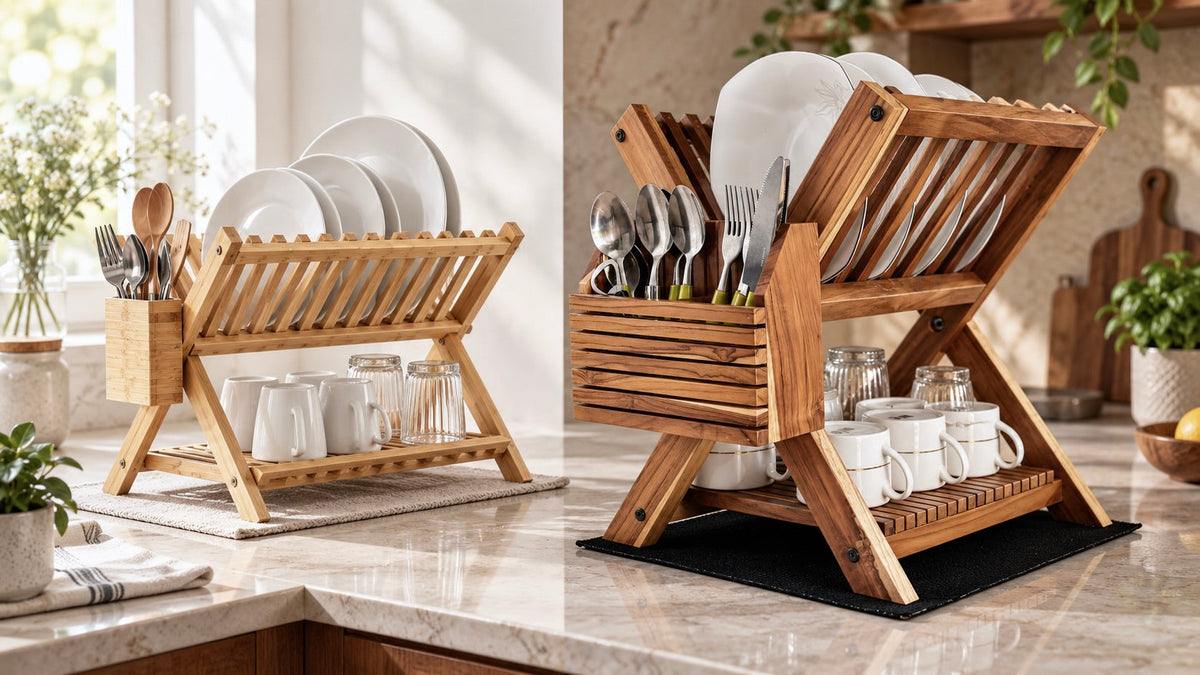
Teak and bamboo dish racks can both bring a natural look to the kitchen, but they are not the same material and they do not always suit the same buyer. One is typically chosen for a lighter, more affordable setup; the other is often preferred for a more substantial, long-term countertop piece. This guide compares teak vs bamboo dish racks so you can decide which one better fits your kitchen, budget and daily routine.
Choose bamboo if you want a lightweight, usually more affordable dish rack. Choose teak if you prefer a denser hardwood, a more substantial feel, natural grain variation, and a rack intended to stay on the countertop as part of the kitchen. In both cases, construction quality, finish, airflow and proper drying matter.
Teak vs Bamboo Dish Racks at a Glance
| Factor | Teak Dish Rack | Bamboo Dish Rack |
|---|---|---|
| Material | Natural hardwood | Grass-based material |
| Typical feel | Dense and substantial | Lightweight |
| Price | Usually higher | Usually more affordable |
| Appearance | Rich grain and natural variation | Light, clean and often more uniform |
| Portability | Heavier | Easy to move and store |
| Best fit | Premium everyday countertop use | Budget-conscious or lightweight setup |
| Maintenance | Needs proper drying and basic wood care | Also needs drying and finish care |
What Is the Difference Between Teak and Bamboo?
The biggest difference starts with the material itself.
Teak is a hardwood. It is known for its dense structure, natural oils and distinctive grain. These characteristics are part of the reason teak has long been used for furniture and products intended for demanding environments.
Bamboo is technically a grass rather than a hardwood. Bamboo kitchen products are generally made by processing and bonding bamboo strips into usable boards or components.
That does not make bamboo a poor material. It simply means a bamboo rack and a solid teak rack should not be expected to feel or age in exactly the same way.
If you want a broader comparison between teak and other common woods, see our Teak Wood vs Other Woods guide .
Which Is More Durable: Teak or Bamboo?
Durability depends on more than the material name printed on the product page.
A rack's lifespan is also influenced by:
- Thickness of the components
- Joint design
- Fasteners and hardware
- Protective finish
- Daily exposure to water
- How often the rack is cleaned and dried
In general, a solid teak rack is likely to feel denser and more substantial than a lightweight bamboo design. Bamboo racks can still perform well, especially when the construction and finish are good.
Do not judge a dish rack only by the words "teak" or "bamboo." Check the actual thickness, construction, joints, finish and dimensions before buying.
Which Handles Kitchen Moisture Better?
Dish racks regularly deal with dripping plates, wet glasses and moisture around the sink, so material choice matters.
Teak is commonly chosen for moisture-prone environments because of its natural characteristics, including its naturally occurring oils and durability.
Bamboo products can also be used successfully in kitchens, but performance depends heavily on how the bamboo has been processed, bonded, finished and maintained.
Regardless of material, neither rack should be left continuously soaked or sitting in standing water.
For detailed cleaning and moisture-prevention advice, read our guide to cleaning a wooden dish rack and preventing mold .
Teak vs Bamboo: Weight and Stability
Weight can be either an advantage or a disadvantage depending on how you use your kitchen.
- You want a heavier, more stable rack
- The rack will stay permanently on the countertop
- You regularly dry larger plates and multiple dishes
- You prefer a furniture-like feel
- You frequently move or store the rack
- You prefer a lightweight kitchen accessory
- Your dish load is relatively small
- You want a compact folding-style design
A heavier rack can feel reassuring when it is full of plates, but a lightweight rack is easier to move when you need to clean the counter or store it away.
Which Dish Rack Is Easier to Maintain?
Both teak and bamboo require basic care because both are natural materials used around water.
For either material, the most important habits are simple:
- Remove food residue
- Wipe excess water
- Allow the rack to dry
- Keep the countertop or mat underneath clean
- Avoid unnecessary soaking
- Follow the manufacturer's finish-care instructions
One important detail is the finish.
A sealed or coated rack should not automatically be treated with oil simply because it is made from wood. The correct maintenance method depends on the finish already applied.
Wood Ceylon's teak dish racks use a sealer and protective top coat, so our normal recommendation is gentle cleaning, removing standing water and allowing the rack to dry between uses.
Which Looks Better in a Kitchen?
This comes down to personal style.
Bamboo usually has a lighter, more uniform appearance. It can fit naturally into Scandinavian, minimalist and light-toned kitchens.
Teak typically has a richer tone and more visible natural grain variation. It tends to stand out more as a piece of woodwork rather than disappearing into the background.
| Kitchen Style | Teak | Bamboo |
|---|---|---|
| Warm natural kitchen | Excellent fit | Good fit |
| Minimal light interior | Good fit | Excellent fit |
| Premium wood interior | Excellent fit | Moderate fit |
| Portable / fold-away setup | Less common | Common choice |
Is Teak More Expensive Than Bamboo?
In most cases, yes. Solid teak dish racks are usually priced higher than bamboo alternatives.
That does not automatically mean the more expensive option is better for everyone.
A lower-cost bamboo rack can make excellent sense for:
- A first apartment
- A rental home
- Occasional dish drying
- A small household
- Someone who frequently stores the rack away
A higher-priced teak rack may make more sense when the product will stay in the kitchen permanently and you care about heavier construction, natural grain and long-term visual appeal.
Compare the rack's dimensions, capacity, construction, finish, included accessories and how often you expect to use it—not only the purchase price.
Should You Choose a Teak or Bamboo Dish Rack?
The best choice depends on your priorities.
- A substantial hardwood rack
- Natural grain variation
- A permanent countertop piece
- Heavier construction
- A premium handmade look
- Custom sizing options
- A lighter rack
- A lower initial price
- A simple compact design
- Something easy to move or store
- A pale, minimal aesthetic
What Makes a Teak Dish Rack Different?
At Wood Ceylon, our dish racks are designed more like small pieces of functional wood furniture than lightweight accessories.
We use solid Sri Lankan teak, thicker components and hand-finishing in our workshop. The larger rack is designed for households that need more capacity, while the smaller version is intended for kitchens where counter space matters.
Our large teak wooden dish drying rack holds up to 15 plates and includes additional storage for cups, glasses and cutlery.
For smaller countertops, the small teak dish drying rack holds up to 8 plates while keeping the same two-level storage approach.
Both racks include a water-collecting drip mat and can be made to custom dimensions on request.
Still Choosing a Wooden Dish Rack?
Material is only one part of the decision.
Before buying, also consider countertop dimensions, plate capacity, airflow, utensil storage and how dripping water will be managed.
Our Wooden Dish Drying Rack Buying Guide explains how to compare sizes, materials and layouts before choosing a rack for your kitchen.
Frequently Asked Questions
Is teak better than bamboo for a dish rack?
Teak is generally better suited to buyers who want a denser hardwood, a heavier feel and natural grain variation. Bamboo may be the better option when low weight and lower cost are more important.
Which lasts longer, teak or bamboo?
There is no single guaranteed lifespan because durability depends on material quality, construction, finish, water exposure and maintenance. A well-built solid teak rack is typically more substantial, while a quality bamboo rack can also provide good everyday service.
Does bamboo handle water well?
Bamboo kitchen products can handle normal moisture exposure when they are properly manufactured, finished and maintained. They should still be kept from sitting continuously wet or in standing water.
Does teak need to be dried after use?
Yes. Teak performs well in moisture-prone environments, but a teak dish rack still benefits from having standing water removed and being allowed to dry between uses.
Is a bamboo dish rack lighter than teak?
In many cases, yes. Bamboo dish racks are often designed to be lightweight, while solid teak racks tend to feel denser and heavier.
Which is better for a small kitchen?
Either material can work in a small kitchen. The more important factors are the rack's actual dimensions, capacity and layout. A compact teak rack can work just as well as a small bamboo rack when it fits the available space.
Which material looks more premium?
This is subjective, but teak is often chosen for its richer natural grain and substantial hardwood appearance. Bamboo usually offers a lighter, simpler and more uniform look.
Should I buy a teak dish rack if I only wash a few dishes?
Not necessarily. If you only wash a few dishes and value low cost or portability, a simple bamboo rack may be enough. Teak becomes more attractive when you want a permanent, substantial countertop rack and value natural hardwood construction.



Leave a comment