


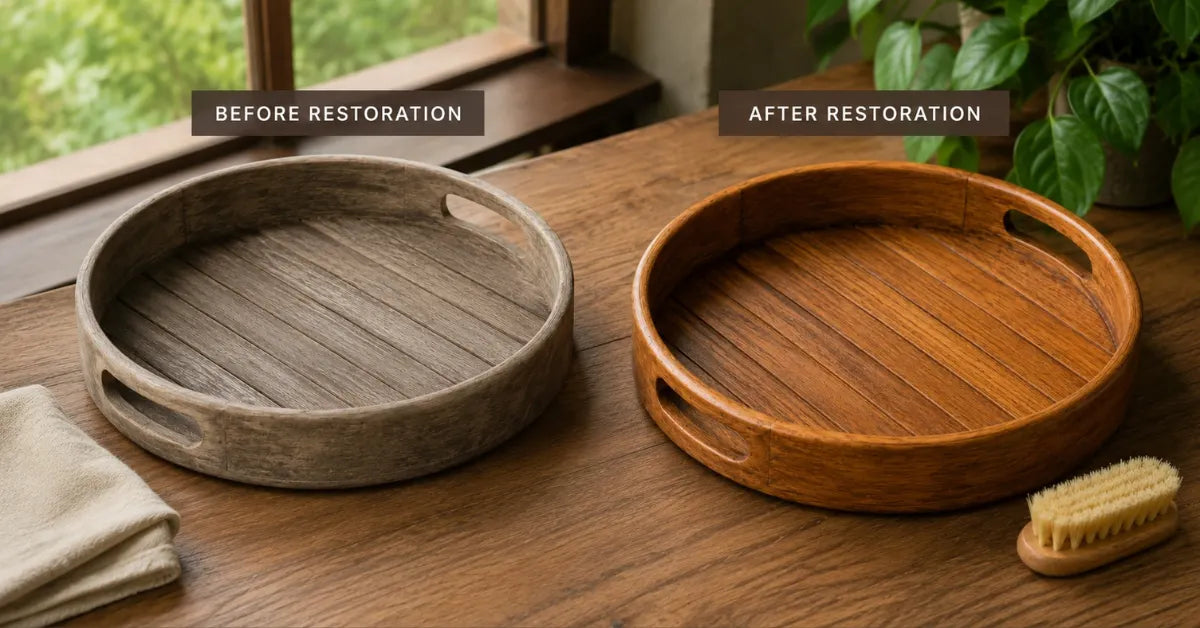
Your old teak has not lost its beauty — it has simply hidden it beneath a thin layer of weathering. Here is exactly how to bring that warm golden glow back, step by step.

Dull silver-grey surface. Rough texture. Stains visible. The piece looks old and forgotten.

Warm honey-golden glow. Smooth, rich grain. Natural oils restored. The same piece — revealed again.
There is a particular kind of sadness that comes from looking at an old teak piece — a carved bowl that has gone grey, a door handle that has lost its warmth, a garden bench that used to glow like amber — and feeling like it has run its course. The good news is that teak almost never has. One thin layer of oxidised surface cells is all that separates you from the rich, honey-golden wood that still exists just beneath.
01 — Understanding the changeWhy old teak loses its glow — the real reason
The golden warmth of teak comes directly from its natural oils. These oils coat each wood fibre from the inside out — they are why teak resists moisture and insects so effectively, and also why it glows the way it does. When teak is exposed to sunlight and open air over time, UV rays break down the outermost layer of wood cells — perhaps just a millimetre or two — oxidising the lignin and turning those surface cells silver-grey. This is what you see when you look at a weathered teak piece.
The grey patina is not damage. It is not rot or decay. It is a natural protective layer the wood grows as a shield against further UV exposure. And because it is only on the surface, the underlying wood is virtually always in excellent condition regardless of how grey or dull the exterior has become.
"The grey patina of weathered teak is not damage — it is a natural shield. The rich golden wood that made you fall in love with the piece is still there, waiting just beneath that thin surface layer, completely intact."
02 — Assessing the pieceHow far gone is it? Reading your teak's condition
Before doing anything, take a few minutes to assess your piece. This determines which restoration approach you need — and saves you from doing more work than necessary.
Mildly weathered
Slightly dull and faded. Some grey tones at edges. Wood still smooth to the touch. Golden colour fading but visible.
Clean + seal onlyModerately weathered
Clear grey-silver patina. Slight roughness when you run your hand along the grain. Possible surface staining or dark spots.
Clean + sand + sealHeavily weathered
Deep grey or black discolouration. Noticeably rough, raised grain. Mildew patches. Neglected for several years.
Full restorationThe wet test: Wet a small hidden area with clean water and observe for 30 seconds. If the water reveals a warm, brown-golden tone beneath the grey, restoration will be very effective and the results will be striking. This test costs nothing and tells you exactly what to expect.
03 — PreparationWhat you will need before you start
Teak dust safety: Teak dust is a known sensitiser — prolonged inhalation can cause respiratory irritation. Always wear a dust mask when sanding, even for small pieces. Work outdoors or in a very well-ventilated space. In Sri Lanka's humidity, dust particles can be heavier and slower to disperse.
04 — The restorationThe full restoration process — step by step
Follow these steps in order. Do not skip ahead to sanding without cleaning first, and do not apply any finishing product until the wood is completely dry. Rushing either stage is the most common reason restorations produce disappointing results.
Before applying any water or cleaner, remove all dust, dirt, bird droppings, and debris using a dry soft brush. Check joints, undersides, and recessed areas — debris accumulates here most and holds moisture against the wood.
All piecesMix mild dish soap in warm water, or use a specialist teak cleaner. Apply with a soft-bristle brush and scrub firmly but gently along the wood grain. For mildew or black spots, apply a solution of one part household bleach to four parts water directly to the affected area for five minutes before rinsing. Rinse thoroughly and allow to dry completely — several hours, or overnight for thick outdoor pieces.
All piecesFor pieces with deep grey staining remaining after cleaning, a teak brightener containing oxalic acid is very effective at restoring the wood's lighter base tone before sanding. Apply as directed, allow to sit, then rinse thoroughly and allow to dry completely before proceeding to sanding.
Heavily weathered piecesSand along the direction of the grain — never across it. For heavily weathered pieces: start with 80-grit, progress to 120-grit, finish with 220-grit. For mildly weathered pieces: start at 120-grit and finish with 220. Apply even, consistent pressure. You will know you have reached fresh wood when the grey disappears and a warm golden-brown tone appears. After sanding, wipe the entire piece with a tack cloth to remove all dust.
Moderate and heavy weatheringAfter sanding, let the piece sit for a minimum of 30 minutes — ideally one hour — before applying any sealer or oil. Sanding raises the wood's surface temperature and opens the grain. Allowing it to rest ensures the pores are fully open and ready to absorb the finishing product evenly.
All sanded piecesUsing a lint-free microfibre cloth, apply your sealer or conditioner in long, even strokes along the grain. Ensure even coverage across the entire surface, including undersides, legs, and edges — these areas are often missed and are where deterioration typically begins. Allow the first coat to absorb per the product instructions, then apply a second coat. Do not apply more than two coats in a single session.
All piecesAfter the final coat's absorption time, wipe the entire piece firmly with clean dry cloths to remove any excess product remaining on the surface. Excess left on the surface dries into a sticky, dust-attracting residue. Buff lightly as you wipe for a more polished result. Allow to cure fully — usually 6–12 hours before light use, 24–48 hours before full use.
All piecesSandpaper grit guide for teak restoration
| Grit | When to use it | What it does |
|---|---|---|
| 60–80 | Heavily weathered, very rough, old varnish present | Removes bulk of grey oxidised layer and old finishes. Leaves visible scratches — must be followed by finer grits. |
| 120 | Moderate weathering, standard restoration starting point | Removes grey layer effectively. Good all-purpose restoration grit for most pieces. |
| 180 | Optional intermediate step | Removes 120-grit scratches before final polish pass. Use for very fine results. |
| 220 | Always the final sanding step | Produces silky smooth surface. Closes the grain slightly for even finish absorption. Always the last step before any product application. |
05 — Finishing productsChoosing the right product — and what to avoid
Teak sealer / protector
Contains UV inhibitors that slow the oxidation process causing greyening. Does not interfere with teak's natural oils. Applied once or twice a year. Best long-term choice for any teak you want to stay golden.
Teak oil
Temporarily restores colour and provides light conditioning. Good for very dry indoor pieces. Needs more frequent reapplication than a sealer. Always wipe away all excess after 20–30 minutes.
Teak brightener
A pre-sanding treatment, not a finishing product. Contains oxalic acid which lifts deep grey staining before sanding. Must be thoroughly rinsed before sanding or sealing.
Varnish or lacquer
Creates a hard surface film rather than penetrating the wood. Looks good initially but traps moisture, then peels and flakes. Very difficult to remove without aggressive sanding.
Avoid linseed oil on teak: Despite being a traditional wood oil, linseed oil is specifically unsuitable for teak. It can cause the surface to become sticky, promote peeling, and accelerate deterioration over time. It is also not food-safe. Avoid it entirely on any teak piece.
06 — Special casesIndoor pieces, carvings, and small accessories
Carved and detailed pieces
For carved teak with intricate detail, power sanding risks losing the crisp definition of the carving. Use a soft-bristle toothbrush or small natural-bristle brush with cleaning solution to work into the recesses. After cleaning and drying, use a fine sanding sponge on the raised surfaces only, following the shape of the carving. Apply finishing product with a small brush rather than a cloth to ensure it reaches the carved detail.
Kitchen accessories and food-contact items
Teak cutting boards, serving trays, and kitchen accessories that contact food need a food-safe finishing product. Do not use teak sealer or regular teak oil on food-contact surfaces. Use food-grade mineral oil or a food-safe wood conditioner instead. The restoration process — cleaning and sanding — is identical. Only the finishing product changes.
For teak door handles: A very light sanding with 220-grit to remove any rough patches, followed by a small amount of teak conditioner applied with a cloth and buffed thoroughly, is all most door handles need to return to their original warmth. The key is buffing — removing all excess so the handle does not feel greasy to the touch.
Teak bathroom accessories
Bath stools, soap dishes, and shower shelves live in the most demanding humid environment of any indoor piece. A teak sealer provides better resistance to constant bathroom humidity than teak oil. Ensure the piece is completely dry before applying any product, and allow to cure fully — at least 24 hours — before returning to a wet environment.
07 — After restorationKeeping the glow for longer
Once you have put the effort in to restore a piece, a simple ongoing routine keeps it looking beautiful and makes any future restoration far quicker and easier.
In Sri Lanka's tropical climate: High humidity and intense UV exposure accelerates weathering on outdoor teak. Clean every 4–6 weeks rather than seasonally, and apply teak sealer twice a year. The good news: teak grown in tropical climates — as our wood is — is naturally more acclimatized to these conditions than imported teak grown in cooler environments.
Every piece is worth restoring
There is something deeply satisfying about the moment a grey, weathered teak piece reveals its golden warmth again. It is not magic, and it is not complicated — it is simply the wood showing you what was always there, waiting to be uncovered. The remarkable thing about genuine teak is that this moment is available to almost any piece, at almost any age, no matter how neglected it appears.
At Wood Ceylon, we make every piece with that longevity in mind. The Grade A teak heartwood we use, handcrafted by skilled artisans in Sri Lanka, is chosen because we know that a piece made well will be worth caring for — and worth restoring when the time comes.
Take the time. Do the work. The glow will come back — and it will be exactly as beautiful as you remembered.
Handcrafted teak worth restoring
Every Wood Ceylon piece is made from Grade A teak heartwood in Sri Lanka — built to last, and built to be worth bringing back when the time comes.



Leave a comment