


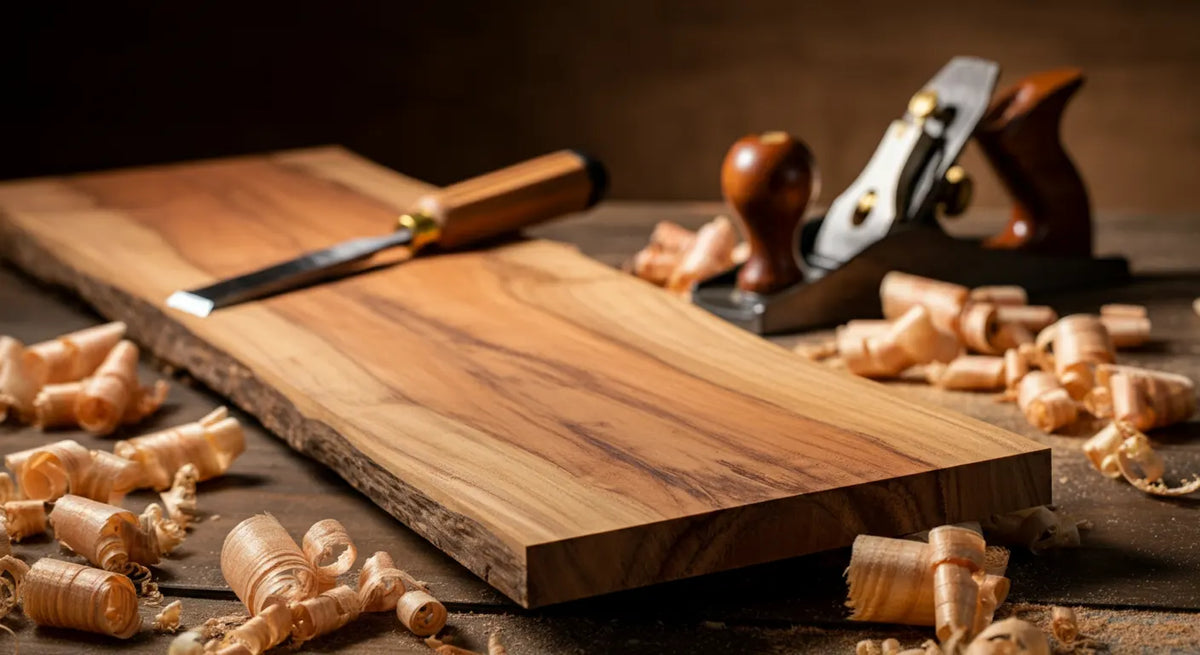
Teak's reputation for durability and natural water resistance makes it one of the most valuable hardwoods you can buy — and one of the most commonly imitated. Here are five practical ways to check whether a piece is genuine before you invest.
Check the grain and colour
Genuine teak typically has a straight, consistent grain, sometimes with gentle waves running through it. Freshly cut or sanded teak ranges from golden honey to a deeper brown, and it naturally darkens into a rich patina as it's exposed to light over time.
Be wary of wood that looks unusually flat or uniform — that can be a sign of staining or a printed finish designed to mimic teak's colour rather than genuine grain.
Test how it feels
Real teak has a distinct feel, thanks to the natural oils in the wood. Run your hand across the surface: authentic teak tends to feel smooth, slightly waxy, and noticeably dense for its size. Those oils are also what give teak its natural resistance to moisture and decay.
If a piece feels unusually light or the surface feels dry and untreated, that's worth a second look.
Try the water test
This is the fastest way to check teak's natural water resistance, and you can do it with nothing more than a few drops of water.
Place two or three drops on a flat, unfinished section of the surface.
On genuine teak, the water beads and sits on the surface for several minutes before slowly absorbing, thanks to the wood's natural oils.
Wood that soaks up the water almost immediately is less likely to be genuine teak.
Notice the scent
Genuine teak has a subtle, distinctive smell — often described as leathery — that's most noticeable when the wood is freshly cut or sanded. Even on older, finished pieces, a faint trace of that scent usually remains. Wood with a strong chemical smell, or no scent at all, is a signal to ask more questions.
Ask about sourcing and documentation
Reputable sellers are generally willing to talk about where their wood comes from. It's reasonable to ask about the species, the grade, and how the wood was sourced. Some suppliers can also provide documentation such as an FSC certificate, which indicates the timber came from a responsibly managed forest.
A price that seems unusually low for the size and finish of the piece, or a seller who can't answer basic sourcing questions, are both worth treating with caution.
Use more than one test
No single check is foolproof on its own, but combining two or three — grain, feel, and water resistance, for example — gives you a much clearer picture. Take your time, trust what your hands and eyes are telling you, and don't hesitate to ask a seller direct questions before you buy.
Every piece we make at Wood Ceylon is crafted from Grade A teak heartwood, so you're welcome to ask us directly about the origin or grade of the wood behind any product you're considering.
Frequently asked questions
Can real teak still float or feel light?
Density varies a little by piece and moisture content, but teak should still feel solid and heavy relative to its size. Something that feels notably light is worth questioning.
Does teak need oiling to stay water-resistant?
Teak's natural oils give it water resistance on their own. Over time, sun and rain exposure can fade the colour and dry out the surface — a separate issue from whether the wood is genuine teak in the first place.
Will the water test damage the wood?
No. A few drops of water, wiped away after observing how it beads, won't harm a finished piece.
Is darker teak better than lighter teak?
Not necessarily — the colour difference is often about age and light exposure rather than quality. Newer teak is typically lighter and will darken naturally over time.
Why does teak cost more than other hardwoods?
Its natural durability, water resistance, and slower growth cycle all contribute to a higher price than many alternative woods.
See these qualities for yourself — browse our collection of handcrafted teak pieces.


Leave a comment