


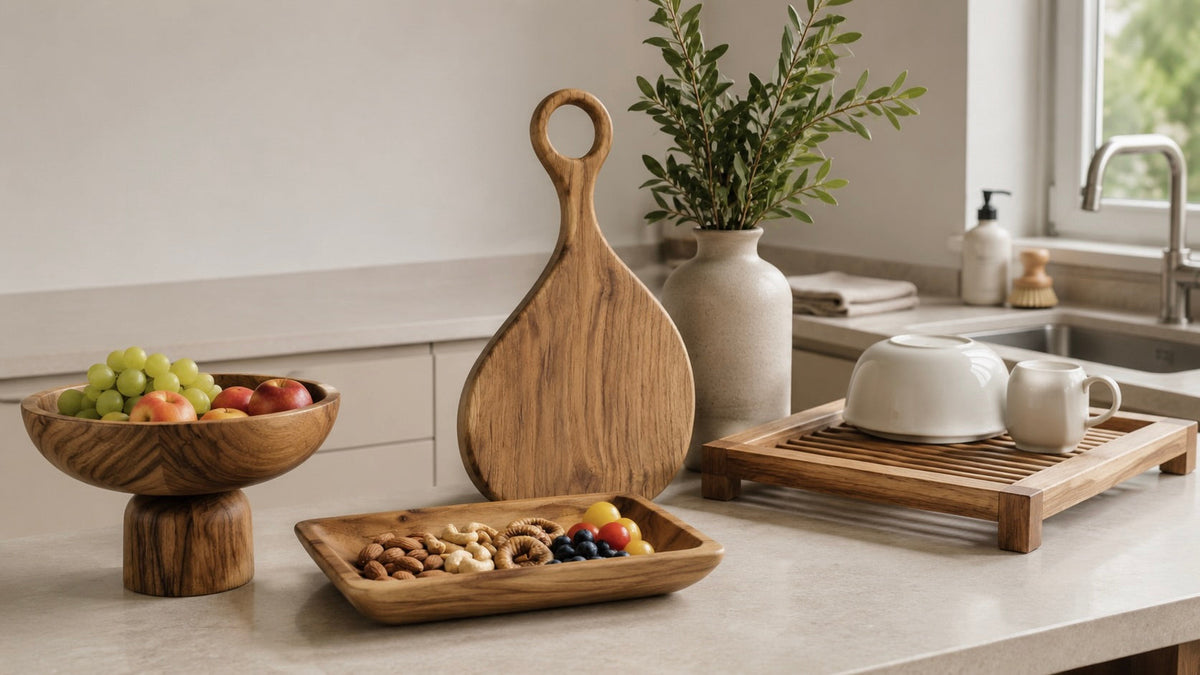
Wooden kitchen accessories bring warmth and texture to a space that's often dominated by hard, cold surfaces — stainless steel, laminate, tile. Whether you're furnishing your own kitchen or specifying finishes for a client project, choosing the right wooden pieces means balancing function with the overall look of the room. This guide walks through the most useful types of wooden kitchen accessories, how to choose them, and how to keep them looking good for years to come.
Why choose wooden kitchen accessories
Wood softens a kitchen visually in a way few other materials can. It pairs naturally with stone countertops, matte cabinetry and open shelving, and it tends to suit both traditional and contemporary schemes without looking out of place.
Beyond aesthetics, wooden accessories are genuinely functional. A wooden dish rack drains water quietly and doesn't clang against your sink the way a metal one can. A wooden cutting board is gentler on knife edges than glass or stone. Serving pieces made from wood also transition easily from prep to table, which matters if you entertain often.
For interior designers, wooden accessories are a low-cost way to introduce a natural material palette into a kitchen without a full renovation — useful for staging, styling shoots or finishing touches on a client brief.
Popular types of wooden kitchen accessories
Some of the most useful wooden accessories for a kitchen include:

Dish drying racks – practical for everyday use and available in larger or more compact sizes depending on counter space. Explore the handmade teak dish drying rack or a small teak dish drying rack for tighter kitchens.

KUBUK Wood Cutting boards – a kitchen staple that also works well as a serving surface, available in custom sizes as well as standard sizing.

Teak Serving trays – useful for entertaining and for carrying multiple items at once, such as this teak serving tray with handles.

Corner Teak Spice racks – a way to keep jars organized and visible, particularly useful in smaller kitchens. See the handmade teak corner spice rack.

Serving bowls and cake stands – decorative pieces that double as functional serveware, such as the handcrafted teak pedestal bowl or teak cake stand.

Bins and waste storage – often overlooked, but a teak wood trash can can be far less visually intrusive than a plastic bin.
You don't need every category at once. Start with the pieces that solve a real problem in your kitchen, then build the collection over time.
How to choose wooden kitchen accessories for your kitchen
Look at what your kitchen actually lacks — drying space, organized storage, a serving solution — rather than buying decoratively first.
Note whether your kitchen leans warm and traditional or cooler and minimal, as this will guide the wood tone and shape you choose.
Measure the counter, shelf or wall area where the piece will sit, particularly for drying racks or spice racks in smaller kitchens.
Ask about the wood type and finish used on a specific product before ordering, especially if you have particular durability or maintenance expectations.
If you need a specific size — a cutting board to fit an unusual counter space, for example — contact Wood Ceylon to discuss what's possible.
Matching wooden accessories to your kitchen style
Wood tone matters more than most homeowners expect. A rich, darker wood tends to suit kitchens with warm cabinetry or exposed brick, while a lighter or more neutral wood can sit comfortably in an all-white or Scandinavian-style kitchen without competing with the cabinetry.
Shape and finish also play a role. Rounded, organic forms — such as a pedestal bowl or a rustic-edged serving board — suit relaxed, farmhouse-style kitchens. Cleaner, more geometric pieces tend to work better in contemporary kitchens with handleless cabinetry and minimal detailing.
For designers working across multiple projects, it's often easier to settle on one or two wood tones per project and repeat them across accessories, rather than mixing several different finishes in the same space.
Caring for wooden kitchen accessories
Wooden kitchen accessories generally need a little more care than plastic or metal equivalents, particularly items that come into regular contact with water, such as dish racks and cutting boards.
Avoid prolonged soaking, keep pieces away from direct heat sources such as stovetops, and dry items promptly after washing rather than leaving them wet.
Specific finishing and care recommendations vary by product, so it's worth checking the details for the exact piece you're considering. For a fuller look at keeping teak items in good condition over time, see Wood Ceylon's teak wood maintenance tips.
Mistakes to avoid when buying wooden kitchen accessories
- Choosing on looks alone. A beautiful piece that doesn't fit your available space or daily routine will end up unused.
- Ignoring maintenance requirements. Wood needs a different care routine than plastic or stainless steel — factor this in before buying, especially for items used daily.
- Buying without measuring. This is a common issue with cutting boards and drying racks, where an ill-fitting piece can crowd a small counter.
- Assuming all wood accessories are interchangeable. Different woods and finishes vary in appearance and durability, so it's worth confirming details for the specific product you're buying rather than assuming.
Bring wooden kitchen accessories into your home
Wooden accessories are one of the simplest ways to add warmth and natural texture to a kitchen, whether you're furnishing a single home or specifying finishes across a design project. Start with the pieces that solve a genuine need in your space, choose a wood tone that complements your existing cabinetry, and don't hesitate to ask about custom sizing when a standard product doesn't quite fit.
Explore the Kitchen Collection to see the full range, or contact Wood Ceylon to discuss a specific size or requirement for your kitchen.
Frequently asked questions
Are wooden kitchen accessories hygienic?
Wood can be a hygienic choice for kitchen use when cleaned and dried properly after use, though care requirements vary by product and finish, so it's worth checking the specific recommendations for the item you're buying.
Can I get a wooden cutting board made to a specific size?
Custom-size cutting boards are available — view the custom-size solid wood cutting board or contact Get Wood Ceylon with your measurements.
Do wooden kitchen accessories work in a small kitchen?
Yes. Compact options such as a small teak dish drying rack or a corner spice rack are designed with limited counter space in mind.
Will wooden accessories match my existing cabinetry?
Wood tone and finish vary between products, so it's worth checking product images and details against your kitchen's colour scheme before ordering, or reaching out to discuss your specific space.
Can interior designers order in bulk or for multiple projects?
For trade enquiries, see the Wholesale – Interior Designers page for more information.
How do I clean wooden kitchen accessories?
General care involves avoiding prolonged soaking and drying items promptly after washing. For more detailed guidance, see the teak wood maintenance tips.



Leave a comment