


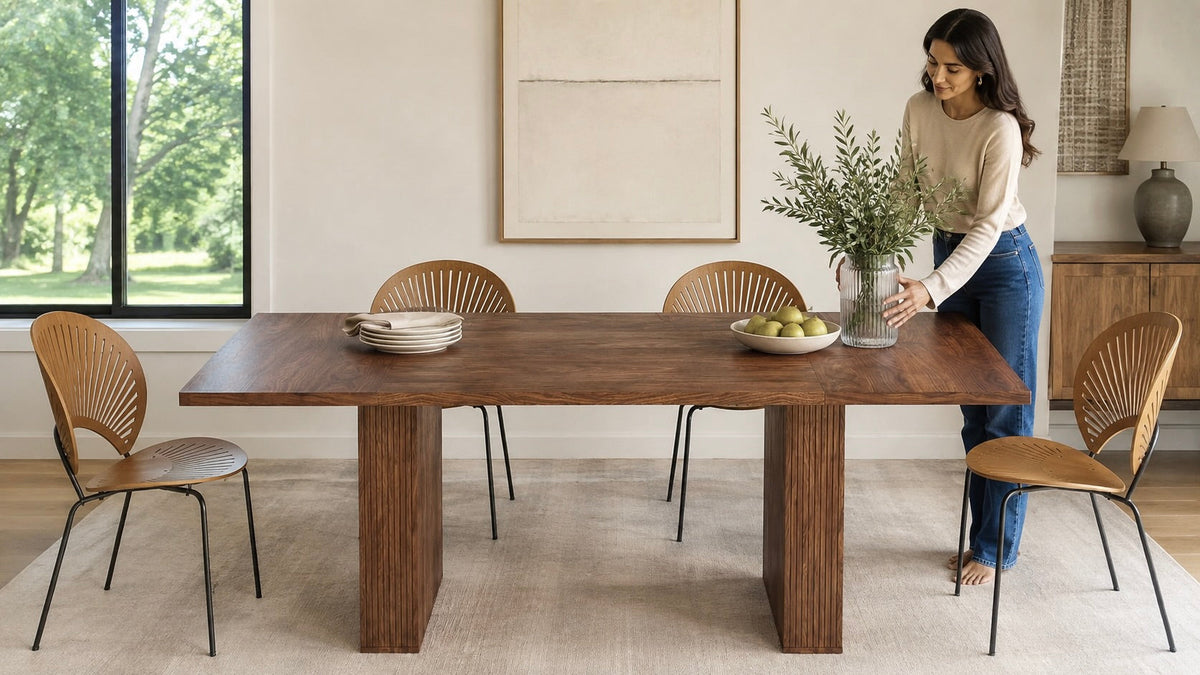
Choosing a rectangle dining table comes down to two questions: will it actually fit your room, and will it seat everyone comfortably? It's easy to fall for a table that looks great in a showroom photo but feels cramped once it's against your own walls, or too small once the whole family sits down for a meal. This guide walks through sizing, seating capacity, material considerations and the small details that make the difference between a table that works and one you regret.
Why a rectangle shape works for most dining rooms
A rectangle dining table is the most common shape for a reason. It fits naturally against a wall, lines up well in a rectangular room, and makes efficient use of space along its length — which is exactly what most dining areas need. Long, narrow rooms in particular tend to suit a rectangle far better than a round or square table, since the shape follows the natural flow of the space instead of fighting against it.
Rectangle tables also scale well. A family of four and a household hosting eight guests can both work from the same basic shape, just at different lengths. That flexibility is part of why the rectangle remains the default choice for dining furniture.
Standard rectangle dining table sizes and seating capacity
Seating capacity depends mainly on length, with width playing a smaller supporting role. As a general guide:
| Table Length | Approx. Width | Typical Seating |
|---|---|---|
| 120 cm (about 4 ft) | 75–85 cm | 4 people |
| 150–160 cm (about 5 ft) | 85–90 cm | 4–6 people |
| 180 cm (about 6 ft) | 90–100 cm | 6 people |
| 200–220 cm (about 7 ft) | 90–100 cm | 6–8 people |
| 240 cm or longer | 100–110 cm | 8–10 people |
These figures assume roughly 60–65 cm of space per seated person along the table's length, which allows for comfortable elbow room without feeling squeezed. If your household regularly hosts larger groups, it's worth sizing up slightly rather than assuming everyone will fit exactly to the numbers above — extending leaves, benches on one side, or simply choosing the next size up can make a noticeable difference.
Measuring your dining space before you buy
The table itself is only half the equation. What matters just as much is how it sits inside the room once chairs are pulled out and people are walking around it.
A useful rule of thumb: leave at least 90 cm between the edge of the table and the nearest wall or piece of furniture, so people can sit down and stand up without bumping into anything. In smaller dining areas, a narrower table (85–90 cm wide) rather than a shorter one often solves the problem more effectively, since it preserves seating length while easing pressure on walking space.
Choosing the right material and finish
Solid wood remains a popular choice for rectangle dining tables because it tends to age well, can often be repaired or refinished rather than replaced, and develops character over years of use. Engineered wood or veneer options can offer a similar look at a different price point, though durability and repairability vary depending on construction quality.
When comparing materials, it's worth thinking about:
- How the table will be used day to day — a family table used constantly has different demands than one reserved for occasional entertaining
- Whether the finish will need periodic maintenance, such as oiling or resealing
- How the table's tone and grain will sit alongside your existing flooring and furniture
- Whether you want a table that can be customised to a specific length, width or finish, rather than choosing from fixed standard sizes
If a custom size or finish matters to you, it's worth asking directly whether a maker can produce something to your exact measurements, since not every retailer offers that option.
Rectangle vs round: which shape suits your room
Shape is often the first decision, before size or material even come into play.
| Feature | Round Table | Rectangle Table |
|---|---|---|
| Best room shape | Square or near-square rooms | Rectangular or long, narrow rooms |
| Space efficiency along a wall | Less efficient | More efficient |
| Seating flexibility for large groups | Harder to seat 8+ | Easier to seat 6–10 with length |
| Conversation across the table | Easier for smaller groups | Better suited to grouped conversations |
| Visual flow in open-plan spaces | Softer, less linear | Aligns naturally with walls and sightlines |
Round tables suit smaller, more square-shaped rooms and can make conversation easier when there are only four to six people. Rectangle tables generally offer more practical seating for larger households and tend to make better use of space in rooms that are longer than they are wide.
Common mistakes to avoid
Buying to the room's overall size instead of the walking space around the table. A table can technically fit a room and still make the space feel cramped once chairs are added.
Underestimating how many people will actually sit down. It's easy to plan for a household of four and forget that holidays, birthdays and casual guests mean the table needs to stretch further, at least occasionally.
Ignoring width in favour of length. A table that's the right length but too wide for the room can be just as awkward as one that's too short.
Choosing a finish without considering maintenance. Some finishes need more regular care than others, and it's worth knowing that before the table arrives rather than after.
Not checking access points. A table that won't fit through a doorway or up a narrow staircase is a genuinely common and avoidable problem.
Finding the right table for your space
The right rectangle dining table is less about finding the "best" option on paper and more about matching length, width, material and seating capacity to how your household actually uses the space. If you're weighing up standard sizes against something made to your own measurements, it often helps to talk it through with the room's dimensions in hand rather than guessing.
Get in touch with your room measurements and we can talk through what's possible.
Frequently asked questions
What size rectangle dining table do I need for 6 people?
A table around 180–200 cm long generally seats six comfortably, assuming roughly 60–65 cm of space per person.
How much space should I leave around a rectangle dining table?
Aim for at least 90 cm between the table edge and the nearest wall or furniture so chairs can be pulled out and people can walk past comfortably.
Is a rectangle or round table better for a small dining room?
It depends on the room's shape. Long, narrow rooms usually suit a rectangle table better, while square or near-square rooms often work well with a round table.
Can a rectangle dining table be made to a custom size?
Some makers offer custom sizing, but this varies. It's worth confirming directly whether your preferred length, width and finish can be produced to your exact measurements.
What's the standard width of a rectangle dining table?
Most rectangle dining tables range from 85 cm to 100 cm wide, with narrower widths suiting smaller rooms and wider tables offering more comfortable place settings.
Do I need extra space for a bench instead of chairs?
Benches can save some width along the table's length, but you'll still need clearance behind them for people to sit down and stand up comfortably.



Leave a comment